
The Evolution of the Battleship (part 3)
In the last episode we saw how the threat across the channel drove the British Government to establish the Bank of England, explicitly in order to pay for a fleet that could defeat the French. The increase in money in the economy brought about by the creation of the Bank indirectly kick started the Industrial Revolution. It is this revolution that permitted the development of what you might recognise as a ‘Battleship’…
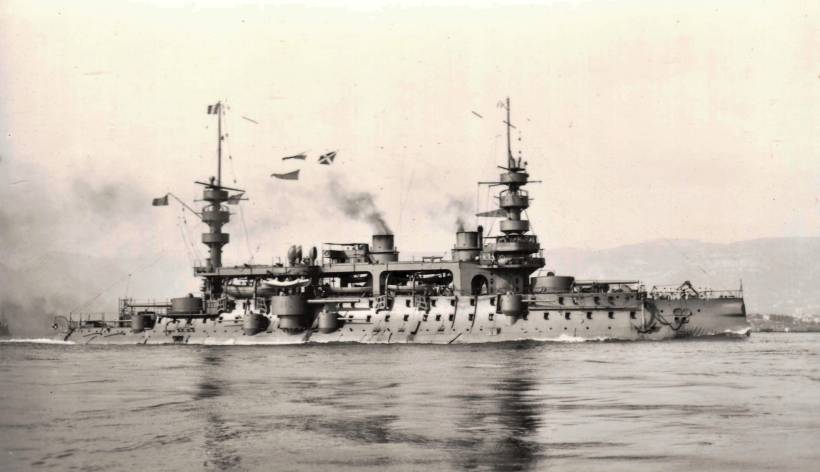
ABOVE: The Charles Martel was built for the French Navy in 1897 in response to the British naval construction program. She had an active service career of only 5 years before being surpassed by the rapid advance of technology at that time. Photograph By Marius Bar. Public Domain, wikimedia curation id 93896746.
The Industrial Revolution was a hotbed of new technologies, many of which were quickly deployed on the battlefield. Steam power allowed warships to move freely, without the need for a favourable wind. Improved metallurgy increased the power of the guns available, and coupled with new explosive shells, made short work of the wooden ‘ship of the line’.
New iron founding practices, however, reduced the cost of iron, making it practical to armour a ship’s sides so they could deflect the new shells. Between 1850 and 1900 the most powerful warships in the fleet changed from wooden sailing vessels equipped with 100 cannons, to warships armed with only a handful of very large guns, mounted in armoured turrets.
The way of fighting changed, from broadside fire starting at a range of 100 yards, and ending with a boarding action, to actions that started at 20km, and would often end catastrophically before the the enemy’s ship was more than a shape on the horizon. The changes cost money; the Royal Navy’s ships were valued at £18M in 1860, and £100M in 1902 (prices exclude munitions), while the need to be able to provision these ships led to the establishment of coaling stations across the furthest reaches of the World’s oceans…
Date: Wednesday 11th November 2026
Time: 19:30 to 21:00
Location: Lancaster Maritime Museum
£4 donation to Lancashire MCS requested
Everybody Welcome
The Evolution of the Battleship (part 3) poster in PDF format (178kB download).
Posted: October 29th, 2026
Posted in MCS talks