CHANGE OF VENUE
Next MCS meeting will be at Carnforth Working Men’s club, NOT at Capernwray (which does not open late evenings until May).
Posted: March 14th, 2013
Posted in MCS talks

Next MCS meeting will be at Carnforth Working Men’s club, NOT at Capernwray (which does not open late evenings until May).
Posted: March 14th, 2013
Posted in MCS talks
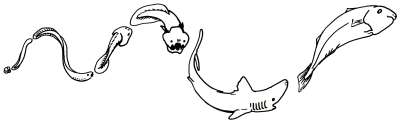
In an excellent talk on the 13th March, Jean Wilson (Blackpool and Fylde College) spoke about fish evolution. The talk followed the development of key characteristics in modern fishes, from the development of the notochord (sea squirts), pharyngeal slits (lancelet), gills, the jaw, cartilaginous (sharks and rays) and bony skeletons. The talk was illustrated both with fossil evidence, and modern examples of more primitive fishes.
The talk was very well presented – with a number of props and completed with a dissection of a hagfish!
Posted: March 14th, 2013
Posted in MCS talks
We have two planned trips to the Oban area later in 2013; on the 28th March and 10th May. At our meeting on Wednesday 13th February the trip organisers (Barry and Gordon) spoke about some possible survey activities that could be undertaken on these visits.
Barry focused on Gallanach, to confirm the presence of Funiculina quadrangularis, and the Wormery in Loch Creran, to confirm the identity of the blue worms photo’d in 2012 (MCS dive trip to Oban (Sept 2012))
Gordon looked to explore new areas around Loch Creran. He also noted that the tides during our trip in March might give us some very good drifts through the Creran Narrows.
Thanks to everyone to turned out for this meeting – in pretty horrid weather!
Posted: February 24th, 2013
Posted in dive trips, MCS talks
Last month’s meeting on Surveying the Piel Channel, by Ron Crosby, drew another big turn out. The Piel Channel is one of the very few satisfactory shore dives along the coasts of Lancashire and Cumbria. Our coastline has very gently sloping muddy bottoms.These make them very susceptible to disturbance from wind or tide, resulting in very poor visibility. It is not that there is no life here – quite the opposite, but it is often dug in and hard to see…
By contrast the tidal race of the Piel channel cuts the boulder-clay sediment to a depth of about 12m within a few metres of the shore. While visibility is still often very poor, the comparatively steep profile means tat all of the life in the bay is compacted into a small area, and a wide range of habitats is very easily accessible.
For more information on the range of organisms found in the Channel, see our surveys page:

An interesting series of presentations looking at some common items washed up on the British strandline. Talks covered the differences between amphipods and isopods (shown above!), some superb images of jellyfish in the sea (my sketches really don’t do these justice!) – and some less attractive photos of them after they have washed up. The activities of baby whelks (you would not invite them to dinner). How to identify a mermaid’s purse – and why you might want to!
Mermaid’s purses are the egg-cases of skates and some sharks, many of the species that produce them are endangered, so recording what you found and where helps build up a picture of the distribution of these species. UK species can be identified and reported online at: www.eggcase.org
Thanks to Ron, Lewis, Gordon and Jo for their contributions to the MCS monthly meeting, 13th June at Capernwray Dive Centre
Posted: June 14th, 2012
Posted in MCS talks
Burrbo Bank & Walney offshore wind farms on Wednesday 9th May was an excellent talk to the group by Peter Sills of DONG Energy. His account of the engineering and political challenges to building offshore wind-farms was fascinating, and resulted in a friendly debate that engaged everyone in the audience.
Wind energy is likely to become a vital part of the energy mix in the UK over the next 20 years, and offshore exploitation does generate less public opposition than land based turbines. For marine life, the hard substrates used to protect cables and turbines from scour provides additional habitat, and the ban on trawling within the farm may be a valuable protection for life that makes use of the softer sea bottom common in the area.
The development of this new mixed ecosystem is likely to be quite interesting…
Thanks again to Peter for his long journey up to visit us!
Posted: May 15th, 2012
Posted in MCS talks