On November 10th at our monthly meeting Barry Kaye gave an excellent illustrated talk on the Gulf Oil Spill. He explained in the most clear and concise way the complexity not only of the problem, but also of the solutions.
It quickly became clear that the human thirst for petrol and diesel driven mobility drives the demand for oil, and that if the economics are right, it will be extracted from the most inaccessible or environmentally sensitive places. The great depth of the Gulf of Mexico site produced it’s own problems, but BP was using ‘state of the art’ technology at the time. There are clearly questions about the quality of some of the technology, but we also learned that this was far from a unique case, instead it is just the latest of a series of accidents in the gulf, involving more than just the BP company.
It would seem that any idea of the Gulf spill having been ‘cleaned up’ is just a cosmetic illusion. The shores and wetlands are a very visible indication of what has been achieved there, and dispersants have removed the oil from the surface waters, but this is just a fraction of the larger impact of the spill. The less obvious but greater impact is out of sight in the mid-depth waters of the Gulf, and on the deeper sea bed. Only time will tell what the longer term impacts are on the ecology of these waters, which in turn will have an impact on surface and inshore marine life.
Gordon Fletcher.
We’ve just added our events diary for January to May 2011 – some good talks to look forward to plus lots of things to get involved with: beach cleans, our annual photo comp., coastal walks and dive/walking/survey trips up to the West Coast of Scotland.
The Lune Deeps are not known for crystal clear visibility. To dive here you have to have the right weather, the right tides, and these have to coincide with time that you can spare to go diving. I have to admit that it would be a first for me. So I was very lucky to get a phone call from Ian at Darwen SAC inviting me on a survey dive in the Deeps. This did mean getting up at 4:00 am a couple of days later on an October Sunday morning, in order to get to Knott End in time to launch for the high tide slack water, but these opportunities don’t come up very often and I grabbed it while I could.
Setting up gear in the car park, it had the feeling of a night dive in the dark. Boats launched, we set off for the chosen site with the sun rising above Blackpool, turning the sky over the bay shades of pink. Fantastic – as a diver what more can you ask for?
Well there’s the dive. The plan was to drop to the sea bed at about 10m just out of the deeps, and to swim over the edge and down the slope; each buddy pair to have a surface marker buoy visible. Things went pretty much to plan for us, we found the sea bed and managed to work down the slope to 30m. We could have gone deeper but my – borrowed – computer had run out of no-stop time and I was wary of running it into decompression.
A Greater Pipefish Syngnathus acus
So, what was it like? Where we started the sea bed had quite a few fist sized pebbles and was silty enough that any misplaced fin kick would reduce visibility to zero; this wasn’t too much of a problem as the tide was running fast enough to move us smartly along and clear the silt away. At the end of the dive we got a glimpse of a clearer, more gravelly sea bed. Throughout one of the most striking things was that the dominant species was bryzoan Hornwrack Flustra foliacea, which is quite an unusual habitat to find yourself diving. The silt covering meant that much of the benthic fauna was difficult to discern, but there was still plenty to see, with numerous Coryphella nudibranchs and even a large Triton Sea Slug Tritonia hombergi. As well as some butterfish and a greater pipefish we did find an area with quite a few goldsinny wrasse, which was a bit of a surprise; several people reported seeing large dogfish.
A sponge (Dysidea fragilis I think) and Oaten pipe hydroids Tubularia indivisia.
An interesting dive, but considering the size of the area that we covered there is still plenty of the deeps undived and waiting to be explored. Would I do it again – certainly.
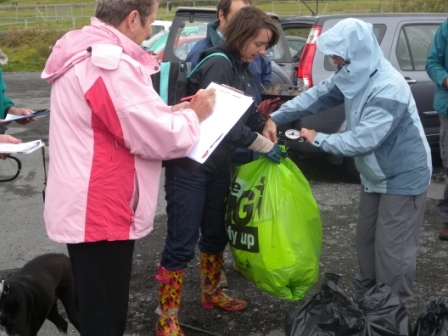
Members of the Group joined forces with members of the Morecambe & Heysham Soroptomists organisation on Saturday 18th. September to conduct a beach clean and litter survey at Half Moon Bay, Heysham. The survey was part of a National survey of beach litter organised by the Marine Conservation Society over the weekend 18/19th. Sept. This annual event attracts thousands of volunteers to clean and record the litter on hundreds of beaches all around the UK coast. Litter on Britain’s beaches has more than doubled since the surveys began in the early 1990’s. Most items of litter recorded , in excess of 60% are made from plastic and in the region of 40% of the litter is left by visitors who come to enjoy the beach. We hold quarterly litter surveys at Half Moon Bay, Heysham, the next one will be on Sunday 19th. December 2010 at11.30am. Why not come along and help?
Photo. images by kind permission of Christine Fletcher.
The centre of a modern city is not usually where you’d expect to find wildlife, but when the city is a port, like Liverpool, the dock areas provide a suitable habitat for a wide range of life!
The footage (linked below) was posted by BBC North West Tonight, and originaly broadcast on Tuesday 14th September 2010. Well worth a look, especially if you thought that old shopping trolleys were the only things you’d be likely to find! The video shows a colourful range of local and imported wildlife:
a broad clawed porcelain crab in the palm of a hand
Thanks to everyone who turned up to brave a rather windy Roa Island. Unfortunately the wind made it difficult to see into pools and the sea at the shore line, and the sky was overcast meaning little light for photography. However it didn’t rain (much) and I think everyone had an interesting time looking for critters with the tide out so far. I was really happy to see the two species of porcelain crab – broad clawed Porcellana platycheles and long clawed Pisidia longicornis – as these have been recorded here before and I have been looking for them at Roa without success. Unfortunately I left my survey sheets in the car at the car share point, but I think it was probably more enjoyable as an informal event anyway; if anyone has any lists/records of what they saw it would be really useful to have a copy to compare with past data.
A hermit crab sizes up a potential new home. It has a firm grip on this new shell, but does it already have an occupant?
The oldest data we have for Roa Island is a survey by Clare & Jones from 1968 and exercises like this walk highlight the rapidly changing landscape of scientific knowledge and naming of species. For instance, one find I have made preparing for the shore walk was the strawberry anenome Actinia fragacea; this species does not appear on the Clare & Jones survey, so is it a new species for this area? The answer is that we can’t tell – in 1968 the strawberry anenome was widely regarded as a colour form of the beadlet anenome Actinia equina, which does appear on the Clare & Jones list and so it could easily have been present. Despite having some excellent baseline data we have to be very careful how we compare our findings today back to it.
The Chagos Islands and surrounding seas were designated a Marine Protected Area by the UK government in early April 2010. The Chagos has the world’s largest coral atoll and 55 tiny islands set in quarter of a million square miles of the world’s cleanest seas. This is the UK’s greatest area of marine biodiversity.
To see short film which shows the wonderful life click on following link: protectchagos.org
As a local area group we try to inform, entertain and educate people about the wonderful marine life in the seas around Britain. We do this through a programme of talks and events – both within our own lecture series, (see our diary) but also to other groups by invitation.
For some years now presentations have been moving to electronic format – Powerpoint(R) and the like, and we have struggled to borrow equipment (thanks to everyone who has helped out!), and with compatibility issues. While we have never yet had to cancel a presentation due to total incompatibility between a speaker’s talk and the equipment to hand, it has come pretty close on a number of occasions…
As a consequence it is a great relief to announce that we have been awarded National Lottery Funding to purchase our own digital projector, laptop and the associated software. While it will take us a couple of weeks to get fully organised, we hope this is the end of pre-presentation worries!
A big thanks to the Big Lottery Fund, and to Jo for co-ordinating our application.
The Marine ID course on Wednesday 9th June looked at two of the most commonly found animals in the sea – starfish and the anemones, or to get more technical, echinoderms and cnidaria. The talks looked at the characteristic features of the two groups, and were beautifully illustrated with photographs of many different species, mostly taken by the speakers in UK waters. Thanks to Gordon and Ron for a couple of excellent presentations!
Conditions for the dive at Roa Island on Saturday 5th. June were almost perfect, bright sun.little wind, calm and undisturbed water which gave underwater visibility in excess of 3 metres.
Swimming approx. SW from the jetty towards the middle of the channel, initially over a sea bed of cobbles covered with tube worms, common winkles and dog whelks with numerous clumps of dog whelk eggs. At about 4 metres deep the bed changed to small boulders with a dense covering of various seaweeds which included sea lettuce and bootlace weed. continuing downward at minus 6 metres the weed disappeared to be replaced on the boulders by a number of species of sponge. Between the boulders were many varied and different animals including peacock worms, anemones, and various species of crab. After a short distance the sea bed changed again to pebbles with hard mud patches, this continued to max. depth of dive at 10.3 metres. There was still lots of life to see on this gentle slope, including hermit crabs, whelks, anemones and the greater pipe fish. The pipe fish were quite common at all depths through-out the dive. On this deeper part of the dive there were many common starfish, a large number with parts of arms missing. They had not been shed, more like cut or torn off, the detached parts were also strewn over the sea bed. All in all an excellent and very interesting dive.