Current climate models offer our best guess at the effects of increasing carbon dioxide levels on global temperatures. The current best guess is that 2°C rise will be OK, and we might get away with doubling the geological average for carbon dioxide concentration in the atmosphere (anthropogenic inputs have so far increased carbon dioxide concentrations by 33%). The problem has been that all of the models are just that – the only experiment is the one we’re living in, and we’d all be happier if we didn’t visit the worst case scenario with this world…
Only there is experimental data to be found in the geological record… Recently scientists investigating oceanic cores have followed an increase of 70% in carbon dioxide concentration that occured in the Palaeocene-Eocene thermal maximum, 55 million years ago. Unfortunately for our current models, this increase in carbon dioxide levels appears was associated with a global average temperature increase of 7°C – twice what our current best guess models are predicting.
More details: Rice University news release (via Science Daily)
Posted: July 15th, 2009
Posted in Uncategorized
The MARINE CONSERVATION SOCIETY runs the biggest annual clean up and beach litter survey in the UK. During the 2008 event 374 beaches all around the UK were cleaned and surveyed, sadly only 12 of all those beaches surveyed were in the North West England Region, (Solway to the Mersey). We would like to see a significant increase in that number in our region, therefore we asking for your help.
Could you and half a dozen friends spare a couple of hours during the weekend 19/20th. September 2009 to clean and complete a simple survey of litter over a short length of your local or favourite beach? In addition to providing valuable information in the battle against marine litter you would also be helping to save & protect our wonderful marine wildlife.
If you can help or would like more information, please contact the following:-
MCS Litter Team. T/phone. 01989567807
E.mail: beachwatch@mcsuk.org
Online. www.mcsuk.org
For local information please contact:- Ron Crosby, Tel. 01282 817776
Posted: July 12th, 2009
Posted in Uncategorized
As the bicentenary of Darwin’s birth, it was very fitting that at least one of our talks this year should feature him, but given the amount of coverage on radio and television already, would the talk bring anything new to light? In the event, by focussing on how his voyage on the Beagle influenced Charles Darwin, Keith Muscott opened a treasure chest of insights into the man and the age that made both the discovery and the dissemination of evolutionary theory possible.
What none of us in the audience had realised at the start of the talk was quite how intellectually challenging the small admiralty survey brigs were in the period following the Napoleonic war. They were crewed by young men with ambition (at peace, there was no other hope for advancement in the navy) and very considerable learning. Navigation at the time was a mathematically demanding occupation, this was a period where mechanical calculators (never mind computers) where unknown, and these vessels produced surveys that remained the standards over large parts of the world until the mid 20th century using nothing more complicated that dead reconning and mechanical chronometers! Where officers on sailing ships were expected to be excellent draftsmen – because there were no cameras, so drawings were the only way of bringing back representations of the far off places and people they visited.
Given this background, we were rather less surprised to find out that most of the officers from the Beagle went on to lives of very considerable distinction…
Barry
Posted: July 9th, 2009
Posted in Uncategorized
For contributors, the MCS blog has just been updated, hope you like the changes to the edit facilities!
Barry
Posted: June 30th, 2009
Posted in Uncategorized
We’re just back from a very welcome long dive weekend near Oban, combined with an informal underwater photography course given by Lewis Bambury. On the 23rd we had two dives starting from the old Creagan Ferry slipway. This is situated on the North bank of Loch Creran, and about 100m after the new bridge, with a good sized layby to kit up in.
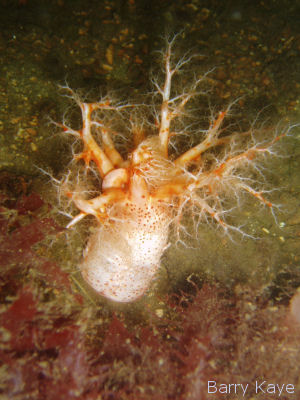
The weather was very wet, and the underwater visibility, at between 2 and 4m was unusually poor for the area – adding to the challenge of getting good photos (good photos were taken by others on the course, unfortunately you’ll have to make do with mine!). The morning dive was a low water bimble around the slipway itself, Loch Creran is home to numbers of sea cucumbers, of which the most commonly encountered is Psolus phantapus (see photo), which is bright orange, and these were the photographic high-spot of this dive, though there were also plenty of crabs, dead-mens fingers and squat-lobsters!
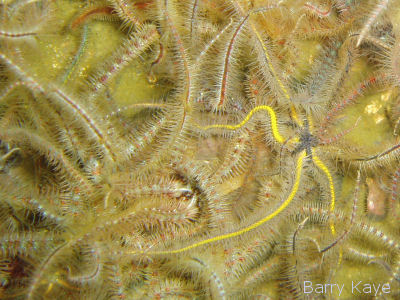
In the afternoon we drifted with the flood tide into the inner basin of Loch Creran – being at springs, there was with strong current. Or at least it was after we found it! – We’d taken a direct bearing to the bridge, and so ended up too close to the North side of the channel to get into the main current until we were pretty much under the bridge itself. Our route did take us through a deep basin immediately North West of the bridge, however (see charts). This contains an extensive brittle-star bed, which looks rather grey and unappealing at any distance, but go in close, and the grey hairyness resolves into myriads of brightly coloured brittle-stars (see photo). These are interspersed with the occasional giant starfish (typically 0.5m from arm-tip to arm-tip).
The final drift through under the bridge was very exhilarating, though with the stronger spring tide it was not possible to stop where we had intended, necessitating a 100m walk in full kit back to the car.
All in all, an excellent weekend, so thanks to Lewis and Gordon (who organised 5* accommodation and dive details).
Barry Kaye
Posted: May 27th, 2009
Posted in Uncategorized
Cod fisheries off the American coast have now largely collapsed, and recent research, by the University of Iceland and Marine Research Institute in Reykjavik, indicates that the remaining commercailly viable fisheries around Iceland are also teetering on the brink.
For a long time we have known that fishing exerts a strong pressure on the size and age at which cod mature. The scientists report that this has resulted in a reduction in the length at which a fish becomes mature by nearly one centimeter per year. The loss in size at maturity has a corresponding loss in fitness, with shallow water fish (the most heavily hunted) having only 8% of the fitness of their deep water counterparts. These changes are almost certainly hereditary, the fish responding to the dead-end that modern fisheries management has forced them into.
The authors speculate that the immediate establishment of large no-take reserves might relieve selection pressures on the fish, and avert a population collapse.
Full article Árnason et al. Intense Habitat-Specific Fisheries-Induced Selection at the Molecular Pan I Locus Predicts Imminent Collapse of a Major Cod Fishery. PLoS ONE, 2009; 4 (5):
This article via Science Daily Headlines
Posted: May 27th, 2009
Posted in Uncategorized
From the Telegraph newspaper, comes this story about an octopus at a German aquarium, who’s bored and angry because it’s shut for Winter and there are no visitors. Apparently, he likes to juggle hermit crabs, rearranged the aquarium, and figured out how to short the lights with carefully aimed jets of water. A warning tale to aquarium owners everywhere- give your octopi plenty to keep them amused!
Here’s another census/catalogue/portal of marine life. OBIS is the Ocean Biographic Information System and claims to be “a spatially and temporally interactive online archive for marine mammals, sea turtles and seabirds data”. It takes contributions from researchers all over the world and is based at Duke University in the US.
Posted: December 12th, 2008
Posted in Uncategorized
From NOAA and National Geographic this week- two fantastic sets of photos. The first is NOAA’s gallery of coral photos. There’s a lot of images here and the galleries are not that easy to navigate around but there are some beautiful pictures, including possibly my favourite: the orange fireworm. The second is from National Geographic, of Sailfish rounding up a school of sardines in the Gulf of Mexico. You can watch the poor sardines being picked off one at a time until none are left, but the sailfish are impressive looking predators too.
Posted: August 22nd, 2008
Posted in Uncategorized
This article in National Geographic comes with some stunning close up images of nudibranchs and even a video from the photographer. If this isn’t enough to convince people that sea-slugs are nothing like their garden counterparts then I don’t know what is!
Posted: May 15th, 2008
Posted in Uncategorized