
Don’t scare the fish
A recent study has shown that using divers and snorkellers is not a good way to count fish. Wile the study is based on coral reef populations, it is pretty well known that while some fish will hang around, and may even be attracted to divers, most disappear as soon as they are aware of your presence…
If we were daft enough to try and work out a population census of the fish we had in British waters by using diver surveys alone, we would have a heavy over-reporting of wrasse (territorial, so come over to ‘look you over’ if you enter their patch) and dragonets (which are interested in looking through recently disturbed patches of sediment – such as those where an ungainly diver has landed – for food items)!
The importance of this work is that it does emphasise the need for a range of reporting and monitoring techniques. What divers are very good for is reporting the types of environments that they find underwater (biotopes – which are stable regions of interdependent organisms), perhaps even more importantly, we can appreciate them, and want to protect them along with their dependent fish (whether or not we see them!).
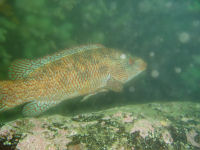
Above right: Photograph of a Ballan Wrasse, taken at Cathedral Rock, St Abbs.
Reference: Faculty of 1000: Biology and Medicine (2009, July 21). Overfishing And Evolution: Fish Fear Their Census-takers. ScienceDaily. Retrieved July 21, 2009, from Science Daily
Posted: July 21st, 2009
Posted in Science