A cracker of crazy stuff from the ocean this issue: Our contribution to shark week this year might be a shark with a hump – or the camel with very sharp teeth… Plus buzzing lobsters, binary snails and when to fix your beach defenses. Perhaps the best news this issue is the partial recovery of the Grand Banks fishing area. White fish stocks had been reduced close to extinction, and this set up feedback loops that resulted in smaller fish and squid taking over, as they ate what few young fish that were born. After over 20 years of ban, however, there are signs that the cod are coming back… Lessons? – Stop fishing before you hit stock bottom (unless you can survive 30 years without work that is)!
Read the rest of this entry »
Posted: August 5th, 2011
Posted in Conservation, Marine science update, Science
INSERT_MAP
Over the last few years we have built up a species list for the Hotel beach and wall at Lochaline. Most of the work has been done by Ron Crosby, with occasional contributions from other embers of the group. This year, however, we are glad to welcome contributions from Ron Ates and Godfried van Moorsel, both based in the Netherlands. Their additions (and corrections) take our list up to 122 named species – not bad at all for 100m stretch of coastline! Mind you the coastline is very conducive to diving, with easy access over a gently sloping beach, leading to a near vertical drop down to 80+m. This makes a wide range of habitats readily accessible to the diver – and reminds us about how much there is in the seas around our coasts.
Below is a quick breakdown table of the life recorded, for a full species list see our survey page:
| Group |
No. Species |
| Algae |
15 |
| Sponges |
8 |
| Cnidarians |
20 |
| Worms |
13 |
| Bryozoans |
4 |
| Crustaceans |
8 |
| Brachiopods |
1 |
| Molluscs |
19 |
| Echinoderms |
8 |
| Tunicates |
9 |
| Fish |
17 |
Posted: August 4th, 2011
Posted in Conservation, dive trips
The coolest story in this issue is the all seeing-eye that sea-urchins apparently have, using light sensitive detectors on the tips of each of their tube feet, which are distributed all around their body! Less good is the prediction of a global marine mass extinction event. Otherwise, a few groups are publishing genetic studies increasing our understanding of how marine organisms biomineralise carbonates. Quite imporant given the expected increase in ocean acidification.
Read the rest of this entry »
Posted: July 12th, 2011
Posted in Conservation, Marine science update, Science
Seven members of the group spent an interesting long weekend at the end of June in the very popular area around Oban. Weather conditions were quite mixed, but we did manage to avoid the showers. A number of dives took place including one on a rocky reef in the inner basin of Loch Creran, then north to the spectacular submarine wall in Loch Linnhe near Kentallon. We also made a visit to the littledived Loch Feochan just a few miles few miles south of Oban. The chart indicated that we could expect to see a lot of mud. The mud was part of the attraction, would we find sea pens and large anemones. From the easy access point, a lay-by right alongside the loch we swam over stones and pebbles covered with various green and brown seaweeds, then onto the gently sloping mud. There were occasional boulders covered with mussels, then at about four metres deep were dozens of the sea slug Philine aperta and the small almost transparent sacks of their eggs. Continuing down the slope to about six and a half metres below the surface where hundreds of sea pens Virgularia mirabilis covered the sea bed. This was only a quick look at a loch that I feel has much more to offer. Many thanks to Jo and Barry Kaye for organising a very enjoyable weekend.
Posted: July 5th, 2011
Posted in Uncategorized
This issue we see that tides keep species apart – or at least prevent the different strains of the ubiquitous seaweed Fucus spp. from all merging into one species! We also see that iron rich waters result in changes to benthic communities and get an insight into how sponges form glass skeletons – a feat of materials engineering that has always amazed me. The tone is decidedly more serious in our Fisheries section, with a link to graphics showing just how much our fish stocks have declined over the last century. Actually ‘declined’ is not nearly a strong enough word for it. ‘Wiped out’ would be a little closer to the mark.
Read the rest of this entry »
Posted: June 19th, 2011
Posted in Conservation, Marine science update, Science
It has been a while, and there is a lot to go through – so best start with some light browsing! – In Science we’ve got links to a super set of marine life photos, plus an amusing look at cnidaria from the guys at Deep Sea News. The section ends with new takes from molecular biology on the flagella and the mitochondrion – fundamental building blocks of cells.
In conservation we look at attempts to model population dynamics across a patchwork of marine reserves. This kind of understanding is essential for planning effective reserves, as if reserves are too small, or the gaps between them are too large, then they will not protect all of the species within them from over exploitation. This section ends with a look at how well displaced populations survive – as aliens in the Med or the Caribbean, or displaced benthic faunal communities.
Fisheries has an interesting couple of articles on cod fishing in the Baltic – I had full access to the PLoS 1 journal article, and that appeared to say that fisheries, seals and cod could co-habit, though there would be problems. The ScienceDaily headline is a lot more strident, in saying that seals will be the financial ruin of small fishermen. Otherwise there is a paper drawing our attention to the possibility that fisheries and climate may not be independent variables. If this is that case it will make modelling fish stock that bit more challenging…
In fact there is a second link between fisheries and climate change this issue, with news that slow growing fish in the Tasman Sea are being adversely effected by temperature rise – the Tasman Sea has increased in temperature by 2°C in the last 60 years. Thankfully the Weddel Sea has only warmed by 0.6°C, but this still represents an enormous amount of heat entering the Southern Oceans from our warming climate. To ensure there is no silver lining in this issue, we learn that bacteria are the true rain makers.
Read the rest of this entry »
Posted: May 24th, 2011
Posted in Conservation, Marine science update, Science
Thanks to Gordon for organising an excellent dive weekend based at Tralee Bay (see map) near Oban last weekend (6th-9th May 2011). Eleven of us from the MCS and Preston Sub-Aqua Club enjoyed some spectacular dives.
INSERT_MAP(220,450)
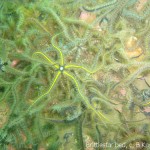 These including a fast run through the Creran Narrows, which Jo and I followed with a linked dive into an eddy pool by the North West shore, to get some better photos of the brittle star beds there, (it never ceases to amaze me how much colour there is in these beds, which appear from a distance to be rather unpleasant grey cob-webby places) before a rather hard swim back on the surface.
We also visited the wormery – where the serpulid reefs seem more substantial than ever – less substantial reefs are also to be found in the inner basin of Loch Creran.
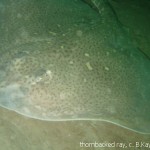 Our final dive though was at Galanach, where I wanted to visit the sea-pen beds, with the intention of getting some better photos. As a rather nice bonus, however, I saw a large thorn-backed ray, which hung about long enough for me to get his mug-shot!
We also managed a small amount of microscopy, looking at a single plankton sample from Galanach. Unfortunately the phytoplankton have now disappeared (they formed a substantial component of the samples at Lochaline last month), though there is a large amount of zoo-plankton, with copepods and barnacle larvae (cyprids) as the major component.
Posted: May 11th, 2011
Posted in dive trips
Usually we start the science section with stories from the vertebrates, and work ‘down’, in a blatant piece of species-ism. This time the anemones float to the top, however, with reports of how the corals might have evolved, and the id of one of the chemicals that induces their free-floating larvae to settle down. We end the section with a series of parties with the world’s largest vertebrates.
Fisheries and exploitation has a report about fishermen being paid to collect plastic. Sounds environmentally beneficial? We’re not sure how the collection will work, as while there is a vast amount of plastic waste at sea, is is usually in small fragments and not very concentrated, making for a very energy intensive clean-up. A skimming exercise that would remove small fragments will also remove many of the small invertebrates and plankton that form an essential part of the food chain… It will be interesting to see if there are any benefits from this bit of horse-trading.
Read the rest of this entry »
Posted: May 5th, 2011
Posted in Conservation, Marine science update, Science
A life and death issue, with a look at the short lives of copepods in our science sections, followed in exploitation by a look at how tunicates may hold the secret of a prolonged life for all of us. In conservation we ask if traditional conservation practice is the best way of protecting the marine ecosystem, and see that anoxic waters don’t stay buried!
Read the rest of this entry »
Posted: April 25th, 2011
Posted in Marine science update, Science
A very successful trip to Lochaline on the West coast of Scotland was enjoyed by ten members of our group. General weather and sea conditions over the four days was on the whole very good. Based at the Old Post Office in Lochaline we were only a couple of hundred yards from the access point to a spectacular dive location, the Hotel Beach Wall. The dive starts off swimming down a very gentle slope of mainly white silica sand with occasional large boulders covered with kelp and sheltering shore crabs and sea stars etc. as the slope gets steeper tube anemones, Cerianthus lloydii in a variety of colours are very common. The sandy slope ends quite abruptly as we reach the top of the almost vertical wall which plunges down to a depth of more than one hundred metres. Just a few of the very common inhabitants on the wall are Tubularia with numerous nudibranchs, football sea squirts, squat lobsters, feather stars and sponges etc. We are also able to add a further two animals to our Group’s list of recordings for this dive site, a lumpsucker, Cyclopterus lumpus spotted on a couple of dives and a number of Brachiopods, (lamp shells) Terebratulina retusa. Dives also took place at Fiunary Rocks, a typical sea loch slope further West along the Sound of Mull and on the sea grass beds at Rubha-nan-So’rnagon in Loch Linnhe.
Most members of the party spent some time walking in the area, on the shores of Lochaline, to see the carved stones at Kiel and to the East side of the loch to the fossil burn where we were very lucky to see otters.
Many thanks to Jo and Barry for such a well organised trip.
Posted: April 22nd, 2011
Posted in Uncategorized


