Lots of stuff in this roundup in which we travel in time from an up-to-date science review from the gulf oil spill (handy for next month’s talks!) back to ancient cnidaria. Exciting changes in fisheries protection for the US Pacific fleet, which is to see the number of boats reduced to match the number of fish that can be legally caught. More on the formation of shoals – what is the cost of grouping together for protection? To start, however, a first glimpse into the life of one of the largest groups of marine organisms – the bacteria: Read the rest of this entry »
Lots of pollution – the Deepwater Horizon was now the largest spill ever (official). Problems with policing conservation policy. How alike are flocks and shoals? Read on… Read the rest of this entry »
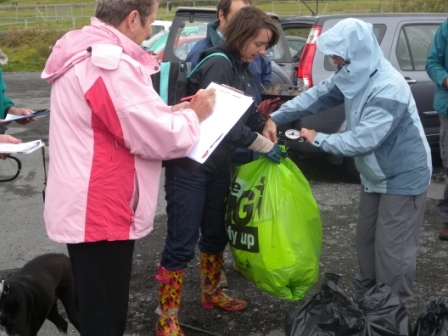
Members of the Group joined forces with members of the Morecambe & Heysham Soroptomists organisation on Saturday 18th. September to conduct a beach clean and litter survey at Half Moon Bay, Heysham. The survey was part of a National survey of beach litter organised by the Marine Conservation Society over the weekend 18/19th. Sept. This annual event attracts thousands of volunteers to clean and record the litter on hundreds of beaches all around the UK coast. Litter on Britain’s beaches has more than doubled since the surveys began in the early 1990’s. Most items of litter recorded , in excess of 60% are made from plastic and in the region of 40% of the litter is left by visitors who come to enjoy the beach. We hold quarterly litter surveys at Half Moon Bay, Heysham, the next one will be on Sunday 19th. December 2010 at11.30am. Why not come along and help?
Photo. images by kind permission of Christine Fletcher.
The centre of a modern city is not usually where you’d expect to find wildlife, but when the city is a port, like Liverpool, the dock areas provide a suitable habitat for a wide range of life!
The footage (linked below) was posted by BBC North West Tonight, and originaly broadcast on Tuesday 14th September 2010. Well worth a look, especially if you thought that old shopping trolleys were the only things you’d be likely to find! The video shows a colourful range of local and imported wildlife:
A good couple of weeks of marine science here – from fun to fundamental stuff, and often both together! Fundamental and important is the possibility that studies of nitrogen uptake in the marine ecosystem may have have underestimated the amounts of nitrogen being fixed by marine organisms. Fundamental and fun – well, take your choice from scampering scallops to the secretive sex-life of snails!
In conservation the emerging issue is deep-sea bottom trawling; there doesn’t seem to be any way of controlling this, so I guess the industry will continue until the stocks crash, taking an entire ecosystem with them (if you care, buy fish from sustainable sources – this does not include any deep sea species!). In pollution the important stories are still with the Gulf Oil Slick, with the publication of BP’s report into the accident, and some interesting strands in the debate as to where the oil has gone…
Fisheries and climate change – the big two marine problems go head to head this week. I couldn’t work out where some stories belonged, so if you are interested in either, scan both columns! My research for a talk in November on the Gulf Oil Spill is getting interesting, with (more) claims of independent research getting elbowed out of the way of a good legal battle! Sour grapes, or serious accusations? First though, something wholesome from the scientific journals: Read the rest of this entry »
The oil spill continues to be important to the marine biology community, which is currently chewing over some of the first reports based on data obtained during the slick and in its immediate aftermath. There is still a lot else to consider – climate change is moving back up the agenda, with indications that we need to address this problem now. We will start, however, 2.5 billion years ago (the lengths I go to to find some good news…) Read the rest of this entry »
a broad clawed porcelain crab in the palm of a hand
Thanks to everyone who turned up to brave a rather windy Roa Island. Unfortunately the wind made it difficult to see into pools and the sea at the shore line, and the sky was overcast meaning little light for photography. However it didn’t rain (much) and I think everyone had an interesting time looking for critters with the tide out so far. I was really happy to see the two species of porcelain crab – broad clawed Porcellana platycheles and long clawed Pisidia longicornis – as these have been recorded here before and I have been looking for them at Roa without success. Unfortunately I left my survey sheets in the car at the car share point, but I think it was probably more enjoyable as an informal event anyway; if anyone has any lists/records of what they saw it would be really useful to have a copy to compare with past data.
A hermit crab sizes up a potential new home. It has a firm grip on this new shell, but does it already have an occupant?
The oldest data we have for Roa Island is a survey by Clare & Jones from 1968 and exercises like this walk highlight the rapidly changing landscape of scientific knowledge and naming of species. For instance, one find I have made preparing for the shore walk was the strawberry anenome Actinia fragacea; this species does not appear on the Clare & Jones survey, so is it a new species for this area? The answer is that we can’t tell – in 1968 the strawberry anenome was widely regarded as a colour form of the beadlet anenome Actinia equina, which does appear on the Clare & Jones list and so it could easily have been present. Despite having some excellent baseline data we have to be very careful how we compare our findings today back to it.
Lots in the press over that last week, with the start of the publication of a new PLoS 1 collection on marine biodiversity, one of the outcomes of the Census of Marine Life (2000-2010). In the conservation field we have encouraging support for marine reserves from US studies, though there is strong indication that multi-use reserves are not as efffective as might be hoped – strongly policed no-take zones are really the only option for allowing the recovery of many areas. Otherwise, we have a number of publications on hard corals – some good basic science for a change in ‘Life at Sea’, plus a look at how well corals establish at higher temperatures in our climate change section.
Marine biodiversity and biogeography: The release of a collection of articles from around the world, each article describes the physical, geological, chemical, and biological characteristics of a region of the worlds oceans. Current papers cover the Pacific, Mediterranean, Caribbean, Antarctic, a US overview, and South Africa. These publications follow on from a decade of work by the Census of Marine Life, that attempted to bring together a corpus of knowledge about the biodiversity of our oceans. PLoS ONE: Marine Biodiversity and Biogeography – Regional Comparisons of Global Issues
We’ve caught a couple of pre-reports on this, but now the full paper is available for all to read at PLoS 1. The report is based on historical fish landings reported from the Firth. This sees a healthy and diverse fishery in the early 19th century. After this date the fisheries effort intensified, and commercial landings for each species targeted in turn is seen to go through a boom followed within a few decades with collapse.
The only commercial fisheries that remain today are reported to be for Nephrops and scallops (Pecten maximus, Pectinidae). The report damns the fishing industry for forcing a repeal of the trawl ban in 1984 that had been put in place since 1889. It further argues that modern intensive Nephrops fisheries are preventing the recovery of other fish stocks.