XKCD’s Desert Island
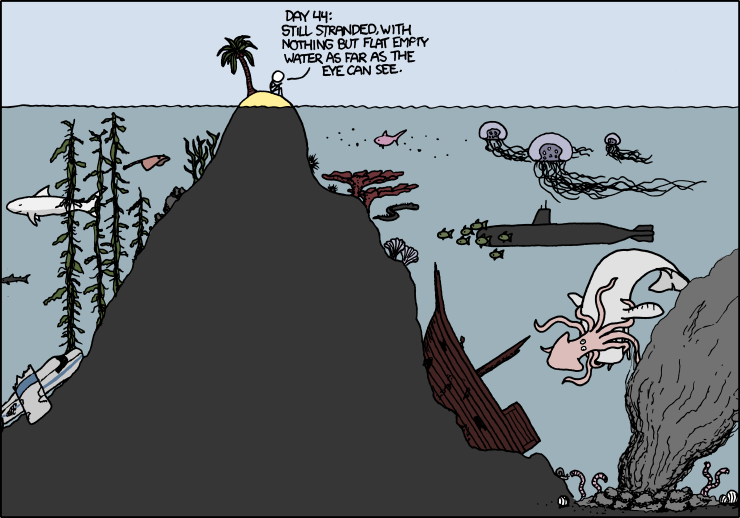
“Day 44: Still stranded with nothing but empty water as far as the eye can see”
More truth in this cartoon than a page of words. Enjoy! (View full size).
Posted: April 28th, 2010
Posted in Uncategorized
“Day 44: Still stranded with nothing but empty water as far as the eye can see”
More truth in this cartoon than a page of words. Enjoy! (View full size).
Posted: April 28th, 2010
Posted in Uncategorized
Each week I scan several thousand blog and news posts, picking out ones of interest to me and writing a bit about them – if I have time. Two problems – selfish interest, and lack of time! Here I’m going to try something a bit different, and be a lot less selective, but only write a very short tag for each item. This way hopefully you get a chance to find stuff of interest w/o having to scan everything…
Here goes my marine science roundup #1:
Plankton’s importance for carbon fixation: In the marine ecosystem both eukaryotes and cyanobacteria are important for fixing carbon at the base of the food chain. This article indicates that the eukaryotes (diatoms, dinoflagellates, protozoa and ‘seaweed’) are responsible for a bit under half the total carbon fixation in the world’s oceans (via ScienceDaily, Apr. 16, 2010).
Seabed Biodiversity in Oxygen Minimum Zones: Lack of oxygen in the water column favours some unusual organisms, and can increase biodiversity (as long as the areas are not too large). From ScienceDaily Apr. 19, 2010.
Smart fish adapt to environmental changes: Living in a changing or dynamic environment seems to favour smarter fish. From PLoS Biology 8(4): e1000351. doi:10.1371/journal.pbio.1000351.
Masses more bugs: The number of microbial species in the world’s oceans may be one hundred times greater than previously estimated. From Nature News, April 18, 2010.
New species of bacterium discovered: I guess given the increase in the number of microbes now expected, reporting each discovery individually might have to go by the wayside – so make the most of it! This one was found in the gut of a worm that lives in a Swedish fjord…
Junk food: A beached whale that died in Puget Sound (US) was found to have a pair of trousers, a golf ball, surgical gloves, small towels, and more than 20 plastic bags in its stomach. The problem with plastic litter is not confined to the US, the MCS organises beach litter surveys around the UK to monitor the state of our seas, and bring pressure to bear to get them cleaned up. You can help – see our diary pages for the next beach cleanup!
Fish oil supplements provide no benefit: The largest ever trial of fish oil supplements has found no evidence that they offer benefits for cognitive function in older people. The trial author noted that the duration of the trial might not have been long enough for any true beneficial effects to be detected amongst this test group of initially healthy older people. From ScienceDaily Apr. 21, 2010.
Big Seas, Big Trouble? An extended article about the effects of increased CO2 on Ocean Acidification, and how that will effect life in the oceans in the coming decades. From Santa Barbara Independent Thursday, April 22, 2010
Carbon dioxide emissions causing ocean acidification: US congressional report finds that CO2 emissions will have unknown effects on marine life (see also previous article). From ScienceDaily Apr. 22, 2010.
What are you eating? DNA analysis shows that a large proportion of the fish eaten in Dublin is mis-sold as something it isn’t. Similar results have been reported in the US, and the problem is likely to be global. From ScienceDaily Apr. 22, 2010.
More than one killer whale? recent DNA profiling data suggests that there is more than one species of killer whale.
Posted: April 22nd, 2010
Posted in Marine science update, Science
We don’t usually try to ID bacteria, but this does not mean that they are unimportant. While each bacterium might be tiny, they can group together in enourmous numbers, and contribute a significant proportion of the biomass of any ecosystem. One recent discovery was a microbial mat lying on the sea floor off the coast of South America that covered an area the size of Greece!
The Census of Marine Life (previously blogged here) estimates that between 50 and 90% of the entire biomass of the marine system is in the form of microscopic organisms.
Our next Marine ID lecture on Wednesday 12 May the will look very briefly at some microscopic algae (phytoplankton), before turning to try and give pointers on how to identify some common (large and easily spotted) seaweeds!
More information:
Giant Undersea Microbial Mat (via Science Daily)
Census of Marine Life
MCS Diary – more lectures/meetings and events
Posted: April 19th, 2010
Posted in Science
Thanks to everyone for supporting this campaign, the Chagos islands have now been designated as a no-take marine reserve.
This declaration will make it the largest marine protected area in the world, totalling more than 210,000 square miles – an area twice the size of the UK. The combination of tropical islands, unspoiled coral reefs and adjacent oceanic abyss makes this area comparable in global importance to the Great Barrier Reef or Galapagos Islands.
More information about the Chagos islands project:
Posted: April 15th, 2010
Posted in Conservation
An octopus? We’re aware of the amazing art of mimicry cuttlefish have, blending into their backgrounds, but their close relative the octopus may go one better again, by pretending to be a fish! The Atlantic longarm octopus, a caribean species, has been filmed mimicing flounder and other bottom-dwelling flat-fish. It is not clear why they do this, but video is available on the National Geographic website. The story is also picked up byt the BBC World Service’s Science in Action. Links for more information:
National Geographic: Atlantic Octopus Mimics Flounders—A First
Science In Action: 12/03/2010 (Ivory trade…)
Posted: March 15th, 2010
Posted in Science

Thanks to Michelle Cooper of Lancaster Maritime Museum for a very beautifully illustrated talk on the river Lune through Lancaster (Wednesday 11th March 2010). Lots of views of activity on the river over the last 400 years, which got everyone in the audience judging how things have changed. The images used to illustrate the talk were from the Lancaster City Council collection. These will be on display at the Maritime Museum until the 11th April 2010. For more information:
Posted: March 11th, 2010
Posted in Uncategorized
The competition is part of the celebration of the silver anniversary of the Lancaster Maritime Museum. Photographs on the COAST theme – from shipwrecks to sandy beaches – are invited. The best entries will be displayed in the Exhibition Gallery.
For further details, including PRIZES, please see the entry form below:
Coast photo competition entry form. (300kB PDF)
Posted: March 8th, 2010
Posted in Uncategorized
by Charlotte Caffrey MSc. FRGS
An exploration of the wildlife, marine life and scenery of Spitzbergen, Greenland and the Antarctic Peninsula.
This is a special event organised by the Preston Society (The Preston Bird watching & Natural History Society) to mark their 3000th. presentation/lecture!
At: 7.30pm on Saturday 28th 27th November, 2010
Location: St. Mary’s Church Hall, Cop Lane, Penwortham, Preston PR1 0SR
Tickets costing £3.50 each available through the Preston Society – full details in the form linked below:
The arctic and antactic – booking form (corrected)
Posted: February 23rd, 2010
Posted in Uncategorized
The three categories this year were Above water, underwater and humerous, and the winners, declared by popular vote at the meeting on the 10th of February were:

Above: In the above water category, Greenland sea ice, by Chrissie Ryan.

Above: In the underwater category, Scorpionfish by Lewis Bambury.

Above: In the humerous category, Fish head by Chrissie Ryan.
Posted: February 22nd, 2010
Posted in Uncategorized
Report on the MCS walk 30th January: The Ribble Way walk between Longton and Penwortham (Preston) is an interesting route. While the land is flat, we walked on the raised levees, which protect the surrounding land from the river Ribble, and so had excellent views over the river and inland. Wildlife included several large flocks of geese, cormorants (one pictured) and a couple of hares.
Thanks to Hilary for organising a very enjoyable day out!
Posted: February 2nd, 2010
Posted in Uncategorized