
The ocean’s dead spot
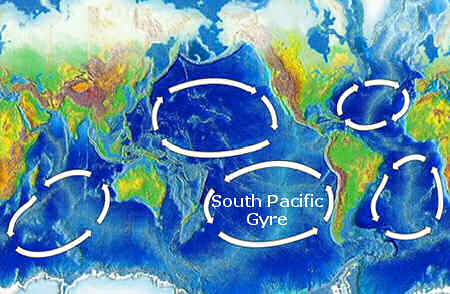 The oceanic gyres are areas of water at the heart of the major oceans. They are a long way from land, so receive little sediment. Estimates of sedimentation rate for the South Pacific Gyre, the largest of these bodies of water, are for less than 10 cm of sediment to accumulate in each million years…
The gyres are bordered by strong boundary currents, but are themeselves almost entirely still. As a consequence, there is very little nutrient influx, the water above is clear, but the sediment contains very little life. Rhode Island Scientists are speculating that the levels of nutrients may be so low that life in the deepest sediments may be reliant on hydrogen produced by water being split by the radioactive decay of minerals in the sediments!
More information:
University of Rhode Island press release (via Science Daily Deadlines)
Image of the five main oceanic gyres modified from NOAA via Wikipedia (full article and original image)
Posted: July 1st, 2009
Posted in Science