The sea is a mysterious place to those of us who only get to visit it for as long as our canned air lasts. In our short dives we often spot things which are puzzling or unexplained. One of the things we’d speculated about on more than one occasion was why sea urchins wear hats.
It is quite a common phenomenon to see them with bits of kelp stuck to their tops – and quite firmly held in place too! – We’d guessed that they might be camouflage, but the truth is a little more prosaic…
Kelp and other seaweeds are not terribly palatable, even to grazing animals such as the urchins. Once the fronds have been broken up, however, then they start to die, and are colonised by bacteria and fungi. As the fronds decompose the amount of protein increases, and they actually become more nutritious. Also, the defensive chemicals (such as phenols) that seaweeds use to deter grazing while they are alive start to disperse, so they become less toxic. As a consequence, it pays an urchin to hold onto a stash of seaweed fragments as a light snack, or possibly even to mature them a little for better eating later.
The urchin’s hat is, therefore, its equivalent of a lunchbox!
Thanks to Little et al. The Biology of Rocky Shores 2nd Ed. publisher OUP, 2009, p105-106 for the enlightenment! Also thanks to Rob for the photo.
Posted: August 20th, 2009
Posted in Science
A recent study has shown that using divers and snorkellers is not a good way to count fish. Wile the study is based on coral reef populations, it is pretty well known that while some fish will hang around, and may even be attracted to divers, most disappear as soon as they are aware of your presence…
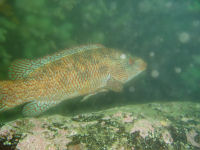
If we were daft enough to try and work out a population census of the fish we had in British waters by using diver surveys alone, we would have a heavy over-reporting of wrasse (territorial, so come over to ‘look you over’ if you enter their patch) and dragonets (which are interested in looking through recently disturbed patches of sediment – such as those where an ungainly diver has landed – for food items)!
The importance of this work is that it does emphasise the need for a range of reporting and monitoring techniques. What divers are very good for is reporting the types of environments that they find underwater (biotopes – which are stable regions of interdependent organisms), perhaps even more importantly, we can appreciate them, and want to protect them along with their dependent fish (whether or not we see them!).
Above right: Photograph of a Ballan Wrasse, taken at Cathedral Rock, St Abbs.
Reference: Faculty of 1000: Biology and Medicine (2009, July 21). Overfishing And Evolution: Fish Fear Their Census-takers. ScienceDaily. Retrieved July 21, 2009, from Science Daily
Posted: July 21st, 2009
Posted in Science
It is vital to be able to reproduce measurements of the physical and chemical properties of seawater, and many years ago this was done using ‘Copenhagen standard seawater’. This was a sample of seawater carefully adjusted to match the standard parameters for the major dissolved ions. Back in those days the primary means of comparing seawater from one area to another was a standard titration of the chloride content, and each laboratory would carefully calibrate their titration against the Copenhagen standard to ensure reproducibility (in practice, usually scientists would perpare a large number of secondary standards from the Copenhagen standard for this purpose, to reduce cost).
This titration measured chlorinity, which was empirically related to the salinity of the seawater, but by only measuring one ion, the relationship was not very accurate or dependable under all circumstances. In the 1960-70’s titrimetry was gradually replaced by conductivity measurements, this was a measurement that was influenced by all of the ions present in the seawater sample, and as importantly, was a lot easier and quicker to perform. The Copenhagen standard seawater continued, however, to be used for standardising the conductivity measurement, though this was strictly designed for the earlier chlorinity procedure. Today we are placing every more reliance on the accuracy of our measurements of the thermodynamic properties of seawater. We now need very much greater precision and accuracy to follow tiny changes in surface seawater compositions, which reflect how the water responds to changes in temperature.
As a consequence a new standard has just been introduced. This uses the concept of ‘Absolute Salinity’, and should help researchers correct for experimental artefacts estimated to contribute up to 1°C differences in current sea-surface models.
Ref: CSIRO Australia (2009, July 20). Science Adopts A New Definition Of Seawater. ScienceDaily.
Retrieved July 20, 2009, from www.sciencedaily.com
Posted: July 20th, 2009
Posted in Science
Tiny single celled plants called phytoplankton support the food chain of the world’s oceans. By locking up carbon dioxide during photosynthesis, they are also recognised as a vital component buffering the earth’s atmosphere from burning fossil fuels.
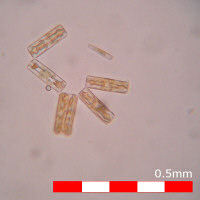
The numbers of phytoplankton are limited by the availability of sunlight and nutrients. Above 50°N in the Atlantic it had been assumed that winter turnover of water masses replenished the nutrient supply, and that the limiting factor for phytoplankton growth was a combination of grazing, and lack of silicates (a vital micro-nutrient for diatoms, pictured). Recently, however, experimental evidence, gathered by scientists at the University of Southampton, indicates that it is lack of iron, another important micro-nutrient, that is limiting the growth of phytoplankton.
Experiments elsewhere, aimed at increasing the amounts of carbon dioxide removed from the atmosphere, have tried to boost phytoplankton production by artificially adding more iron to water bodies.
From Science Daily
Posted: July 8th, 2009
Posted in Plankton, Science

Seagrass is a general term for the only important ‘higher’ plants found in the sea. Unlike algae (seaweeds) they prefer to colonise sandy bottoms, where they are important for stabilising the sediment, and help provide a habitat for a diverse range of wildlife. Whilst seagrass is an important habitat defining species, is is not nearly as competent underwater as the algae, and, in particular, it appears to suffer greatly in turbid (cloudy) water. As a consequence it does not tollerate any coastal development that kicks up silt or increases pollution.
Anecdotal evidence suggests that seagrass meadows in the UK are recovering since the 1930’s when large areas were wiped out by disease. Globally, however, the situation appears to be less good. Scientists from the University of Maryland have just published a report emphasising the relationship between coastal development and increased population pressure in this region around the worl, and its effect o nthis important habitat.
Further reading:
UK Biodiversity action plan for seagrass beds
Loss of Coastal Seagrass Habitat Accelerating Globally (University Maryland report)
Above right: Zostera sp., photographed in Loch Linnh by the author
Barry
Posted: July 6th, 2009
Posted in Conservation, Science
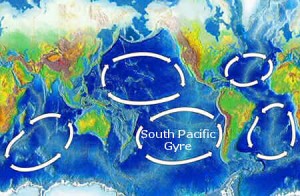 The oceanic gyres are areas of water at the heart of the major oceans. They are a long way from land, so receive little sediment. Estimates of sedimentation rate for the South Pacific Gyre, the largest of these bodies of water, are for less than 10 cm of sediment to accumulate in each million years…
The gyres are bordered by strong boundary currents, but are themeselves almost entirely still. As a consequence, there is very little nutrient influx, the water above is clear, but the sediment contains very little life. Rhode Island Scientists are speculating that the levels of nutrients may be so low that life in the deepest sediments may be reliant on hydrogen produced by water being split by the radioactive decay of minerals in the sediments!
More information:
University of Rhode Island press release (via Science Daily Deadlines)
Image of the five main oceanic gyres modified from NOAA via Wikipedia (full article and original image)
Posted: July 1st, 2009
Posted in Science
Every year we get news of toxic algal blooms killing fish or making water unsafe to bathe in or drink from, but why do algae produce these toxic blooms? The easy answer is that they kill off predators, so the algae survive. Effectively, the toxin is there as a defence against predation. The problem with this theory is that micro-algae have to divert a lot of energy to produce toxins, so in most scenarios the toxic algae would be out-competed by species that did not go to the trouble!
Recently scientists have uncovered a more aggressive reason for toxin expression by algae, and one that gets round this problem. In the new theory the toxin is actually expressed against other algae in the water. Once killed, these dead phytoplankton leak nutrients back into the water that can be used to help fuel a toxic bloom.
From Science Daily Headlines
Posted: June 30th, 2009
Posted in Science
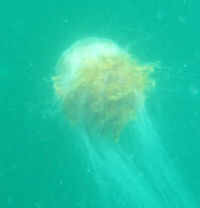
For some time there has been a growing worry about the numbers of jellyfish, with massive swarms being reported in Hawaii and the Gulf of Mexico in late 2008 (Science Daily article).
Jellyfish swarming is a natural event, but evidence is mounting that human activities are favouring these occurrences. Nutrients entering seawater from land run-off increases phytoplankton numbers, and over-fishing reduces the competition for this food. The consequence? – a Jellyfish swarm that can be several kilometres across!
Posted: June 10th, 2009
Posted in Science
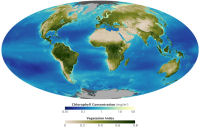
NASA’s Earth Observatory has just published a set of images showing average global primary production fro the period 1999 to 2008. The images show the most highly productive areas of land and ocean by colour (demonstrating again how productive the seas are off the UK). You can see how transient events – like an unusually wet year, can dramatically increase the vegetation levels over desert areas. As the covering notes say, however, it is not so clear why oceanic productivity varies so greatly from one year to the next. For more details and all of the images from this super gallery:
Global biosphere
Barry
Posted: June 8th, 2009
Posted in Science
An expedition, led by Dr Anthony Grehan, has discovered extensive deep water corals, standing up to 2m high, off the Irish Coast. Possible sites for investigation were identified from the high resolution bathymetry collected by the Irish National Seabed Survey, and then identified by deep-sea Remote Operated Vehicle (ROV).
Via Science Daily Headlines
The depth that the corals were recorded at is not recorded in the article, or the main page on the NUI dsite. The Porcupine Bank, close to where the corals were dicovered, is between 80 and 100 fathoms* deep (140-180m), however, so we will not be arranging a dive trip(!). As an aside, the Porcupine bank is named after the Naval research vessel HMS Porcupine, from which the Porcupine Natural History Society also derives its name – small world…
Porcupine Marine Natural History Society
*From Haddock on the Porcupine Bank, September 1944 by C.F. Hickling MA
Posted: May 27th, 2009
Posted in Science