The evening of Saturday 1st August was overcast, with a cold wind, but dry. A small band of us worked down the beach by the new ferry jetty at Roa, following the tide out. The access way used in the construction of the new pier is still comparatively free of marine life, as are the scour pits around the jetty supports, it will be interesting to see how quickly this area gets re-colonised!
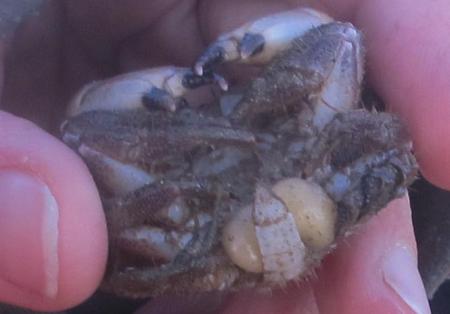
Above: One of the interesting finds form the shore walk was this edible crab (Cancer pagurus) carrying a parasitic barnacle.
Peering in rock-pools and under stones we found a range of plants and animals, including the small male edible crab shown above. Despite being male (indicated by the narrow abdomen tucked up under the carapace) he appears to bearing eggs, but the abdomen is actually tucked around the reproductive organs of a parasitic barnacle (Sacculina triangularis). She will have infected the crab by burrowing into his shell shortly after he moulted. Over a period of time she invades the host’s tissues, and re-programs him, castrating him, dictating future moults (despite his small size, this crab may be quite old!) and re-directing much of his energy to the developing barnacle young.
The young barnacles will be released in the nauplius stage of development, when the females will go on to infect future generations of crabs, whilst the males will develop only as far as cyprids, in which stage they will impregnate established females. Parasitic barnacles are common on crabs, and some crab species have infection rates of up to 50% of the adult population. As a consequence parasites are an important factor in limiting crab populations.
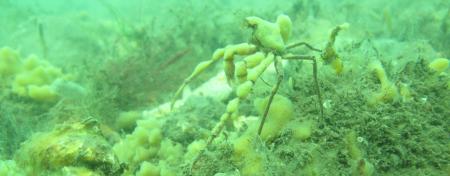
Above: Spider crab (Macropodia sp.) wearing sponge camouflage.
On Saturday 8th August we made the most of a narrow weather window to get a dive at Roa, effectively taking the shore walk out into the permanently submerged part of the channel. Diving conditions were very good for the area, with underwater visibility between 0.5 and 1m. I was paying a bit more attention to seaweeds on this occasion, to try and make up for years of neglect in our usual species hunt, and they were a good range of species between sea level (ca. 2m tide) and about 5m depth. The water in the Bay is generally quite murky, largely as a consequence of the amounts of phytoplankton in the water. These phytoplankton blooms make the Bay one of the most productive ecosystems on the planet, but paradoxically they make life difficult for permanently attached seaweeds, which tend to be stunted, and restricted to comparatively shallow water. Otherwise we saw lots of anemones, crabs, sponges and butterfish. The numbers of peacock worms may be down on previous years, but the general impression is one of a thriving ecosystem.

Above: The butterfish Pholis gunnellus is a common sight at Roa. It gets its name from its slippery, slime-covered body. In previous years we have seen young butterfish taking refuge within the tentacles of the larger anemones (Urticina spp.), where their slime may protect them from being stung and eaten by the anemone, whilst the anemone protects them from other predators.
INSERT_MAP

 We were able to look back on quite a successful year at our AGM. Highlights for the group included a well attended Marine Life ID course at Leighton Moss, and ongoing series of meetings at the Gregson – which we hope to repeat, subject to our being able to come up with a suitable theme! The group made a profit of £130 from talks and events over the year, which has been donated to National MCS. A similar sum has been raised through pin-badge sales on our stand, and through Capernwray Dive Centre (to whom again our thanks!).