Presented by Lewis Bambury at Capernwray Dive Centre, this talk reviewed some of the photographs taken on the shore walk at Roa Island in July, and put this into the broader context of our previous surveys of this area.
The parasite Lernaeenicus sprattae shown on a juvenile spratt, and after removal
One of our mystery organisms (pictured) was a parasite on one of the juvenile spratts caught in the rock pools. Lewis had narrowed it down to probably being a copepod, and this was confirmed by David Fenwick and Mike Moon, who identified the species as Lernaeenicus sprattae. Commonly seen on Spratts in UK waters, it gets its name from its preferred feeding mode, attached to the eye of the unfortunate fish. Extensive parasitism is possible, and this can result in considerable deterioration in the health of individual fish. The two green appendages are egg sacks.
Some of the other organisms featured in the talk are shown in the gallery below, alongside some photos taken underwater on the same site:
We had a very enjoyable visit to the beach at Roa Island on 24th August July, the weather was super, the water (fairly) warm, and there was plenty to see; so a great success! We will be looking at some of the photos taken at our meeting in August (see our diary for up to date details), and putting these into context of our long-standing interest in the marine life at Roa, and the Bay area in general.
Thanks to everyone for coming along – we look forward to seeing you again in August!
Photo of Ron Crosby on the summit of Ben Nevis in 2006 during the 3-Peaks challenge, a fund raising event for National MCS.
We are sorry to announce that Ron Crosby, a founder member of the Marine Conservation Society, and Chairman of the Lancashire Area Group for many years, passed away on Sunday evening (23rd June 2013) after a short illness.
He was a driving force behind the group for some years, and we will miss his enthusiasm, knowledge and unrivaled experience of diving in the UK. He was also active in a number of globally significant marine wildlife conservation projects, particularly that in the Chagos Islands.
Our thoughts are with his wife Rita, also a staunch supporter of the group, and his family.
Above: Photograph of the Roa Island lifeboat station at sunset, with Piel Castle in the background, taken Wednesday 19 June 2013
Our next monthly meeting will take place at Roa Island, a site which has been visited and surveyed by our group for at least twenty years! The meeting, from 18:30 on Wednesday 24 July, is an informal shore walk to coincide with an exceptionally low tide, so we hope to see a lot of sea life exposed on the beach and in small pools that we would normally have to dive so see.
Just so the divers aren’t left out, we have a small number of high water dives planned in the run up to the shore walk*. The first of these was on the 19th June in near perfect conditions. Diving close by the pier and lifeboat station we saw a number of the same creatures underwater, that we will get to see exposed in a few weeks time.
At our August meeting (back at Capernwray Dive Centre) we hope to bring together the shore walk and dives (and maybe earlier survey work) to get a ‘hands on’ picture of life above and below the tide at this very interesting local site.
Please note: The walk in July is suitable for (accompanied) children, but be aware that the beach is very muddy, and you should wear shoes or boots that you are happy to get wet and dirty. If you bring a camera – best to have an underwater housing for it in case… You are free to explore, but most people stay within site of the pier, so it is not important if you arrive late.
Journey time from Lancaster – about one and a half hours, all welcome!
INSERT_MAP
* Please note that dives at Roa Island are very dependent upon the weather, so there are a number of possible dates in the diary that we shall ‘cherry pick’ from…
We’ve got our new calendar online, covering September 2013 through to April 2014. As yet the Roa island dives are not in the calendar, but the first possibility is for Wednesday 19th June, meeting at about 19:30 BST. The weather is looking a little iffy for this with wind swinging round to the NW for Wednesday. Well get other dates online asap.
We have a possible trip to Lochaline in May 2014. This trip is usually for five nights with a mix of divers and non-divers, but to run this we really need 10 people (sleeping 2 or 4 to a room), and to get a good date we’ll need to book soon, so if you are interested please contact Barry!
Also, a big thank you to everyone who came along on Sunday for the beach clean and litter survey! Data is being processed, and hopefully we’ll get a short report on that in the next meeting.
Presented by Lewis Bambury and Gordon Fletcher of the local area group, these talks on the 12 June 2013 at Capernwray Dive Centre looked at some typical dive sites in the North West of England.
Gordon introduced the topic with reference to the local geology, which was completely re-modelled by the last ice age. Offshore this leaves three dominant ecosystems – extended, shallow, muddy plains dotted with the remains of drumlins which provide a scatter of ill-sorted boulders and pebbles, plus the Lune Deeps – a U-shaped glacial valley that reaches depths in excess of 60m. The fine sediments make for difficult diving conditions, as witnessed by Lewis’ introductory slide, and a diver interested in marine life needs to acclimatise to an environment that is nearly monochrome, covered in a fine silt that lifts into an impenetrable veil with the slightest fin kick.
INSERT_MAP
Above: approximate location of the Hebe at the entrance of the channel to Preston Docks.
The ecosystems, while shallow, are dominated by animal life due to the fine suspended silt that cuts off the sunlight needed by seaweed. The mud is inhabited by secretive, burrowing worms, molluscs and crustacea – species we don’t see on most popular dive sites. Where a solid substrate is provided either by a wreck, or by a boulder scatter, the species mix is dominated by hornwrack (a common find on the strand-line around the Bay), with sponges, anemones and hydroids also being abundant. Lewis’ photos showed the dramatic difference between the mud plains and the site of the Hebe, a steamship stranded on Horse Bank 11th December 1911, with the plains apparently featureless with the odd worm-cast, starfish or antenna hinting at the presence of life beneath the surface, whilst the old iron plates of the Hebe bloomed with a profusion of plumose anemones, with mussels and hydroids filling any available gap.
Lewis thanked Darwen Sub Aqua Cub (based near Blackburn) for inviting him to join them on visits to the Hebe and the Lune Deeps.
The talk was prefaced by a short introduction to our beach-clean program by Jo Kaye. The next beach cleans at Half Moon Bay are scheduled for Sunday 16th June and Saturday 21st September 2013.
Our latest visit to Oban on the 10th May was wet in every sense of the word – with almost continuous rain, but also some exceptionally good diving. Dives centred on Loch Creran, with the wormery and the inner basin being popular with all of the group.
Following from the talk about surveys in the area on the 8th, we can confirm that there are quite a lot of orange coloured worms (Serpula vermicularis) – these being seen by several divers, and possibly accounting for several percent of the individuals seen. While none were as clearly yellow as the single specimen photo’d back in 2007, this is a pretty strong indication that yellow is at least possible for this species (see gallery).
Less good news on the sea-pen front, however. A dive at Loch Feochan turned out a large number of common sea-pens (Virgularia mirabilis) in very shallow water (3-5m). Amongst these were a large number of juveniles that looked a lot like the specimen photographed at Gallanach over Easter (see gallery). After a discussion with Ron I am forced to concede that there is no current evidence for Funiculina quadrangularis at Gallanach, though Ron has seen this species there on previous occasions… (We’ll have to look again!).
Reef of Serpula vermicularis showing range in colours
Photo of the juvenile form of the common sea pen Virgularia mirabilis
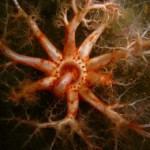
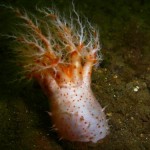
Sea cucumber Psolus phantapus, oral view
Unidentified sea cucumber, oral view
Psolus phantapus, side view
Unidentified sea cucumber, side view
Cerianthus lloydii
Ciona intestinalis on an old mooring line
Otherwise a great spectacle was put on by sea-cucumbers, with very large numbers of Psolus to be seen below about 10m in the inner basin of Loch Creran – densities reaching several individuals per square metre. There were some sea cucumbers in the outer basin as well, but in slightly deeper water (ca 18m+). There appears to be at least one other species present – but I’m not sure of its identity (photo in the gallery). Other high spots of the weekend included a thornbacked ray and a couple of dogfish.
Non divers enjoyed the Falls of Lora, and an excellent trip to the Oban Sea Life Centre (where thornbacked rays and dogfish were demanding petting!), but it was a bit damp for cycling or kayaking…
Thanks to Tralee Bay for accommodation and Gordon for organising the trip.
This Easter was one of the coldest we’ve had in several decades, but the weather was clear and sunny on the West Coast of Scotland, indeed, it was the driest I’ve ever seen it there! The cold snap made for very cold diving conditions – coldest at 5°C in the Inner Basin of Loch Creran, with most dives being 6°C and only a couple of degrees warmer on the surface. This kept even the keenest of us down to one dive a day – the rest of the day being spent warming up again! The planned diving surveys were at least in part successful despite being frozen out, and I hope to talk about those at our meeting in May.
In addition to the diving there were kayak trips around the coast, and cycling and walking explorations of Kerrera and diverse places around Oban. Without doubt the best wildlife was to be seen from a hotel on the Oban water-front, however, as Chrissy’s photo above attests – a sperm whale… That was rather unexpected!
More information about the sperm whale sighting linked below:
Meet: Warton Crag car park on Crag Rd Warton at 10:00am. This large, free, car-park is situated in an former quarry.Grid Ref: SD 492723. Please share cars if possible. There are no public toilets at the car park, or in Warton Village.
Route: Leave M6 at J35. Take A601(M) to J35a. Take A6 North. After about 0.6 miles turn left on a minor road to Warton. Turn left along Main Street then right into Crag Rd. Warton Crag car park is on the right, approx 0.5 miles along the road.
Walk: A circular walk around Warton Crag and Silverdale taking in Crag Foot, Quaker’s Stang, Jenny Brown’s Point and Jack Scout. A mixture of footpaths, bridleways, embankments, shoreline and some minor roads. Varied landscape, superb views and attractive woodland.
Distance: About 9 miles depending upon the wishes of those coming and the weather. The highest point is Warton Crag (163m) and lowest is the seashore,. Quite a lot of ups and downs with a few short steep sections.
Bring: Food for lunch and a drink. At least 1L of liquid if the weather is hot. Walking boots are recommended – as the limestone quarry can be slippery when wet.
Maps: OS Landranger no 97 Kendal, or Explorer OL no 7, Lakes SE.