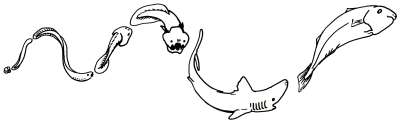
In an excellent talk on the 13th March, Jean Wilson (Blackpool and Fylde College) spoke about fish evolution. The talk followed the development of key characteristics in modern fishes, from the development of the notochord (sea squirts), pharyngeal slits (lancelet), gills, the jaw, cartilaginous (sharks and rays) and bony skeletons. The talk was illustrated both with fossil evidence, and modern examples of more primitive fishes.
The talk was very well presented – with a number of props and completed with a dissection of a hagfish!
An inch of snow greeted early risers in Lancaster on Saturday morning – but the weather held off with just a little wind-blown snow to add to the atmosphere on the walk. This was a repeat visit by the group to Walney – (last visited in summer 2009).
Many thanks to Gordon for organising a very pleasant day out!
We have two planned trips to the Oban area later in 2013; on the 28th March and 10th May. At our meeting on Wednesday 13th February the trip organisers (Barry and Gordon) spoke about some possible survey activities that could be undertaken on these visits.
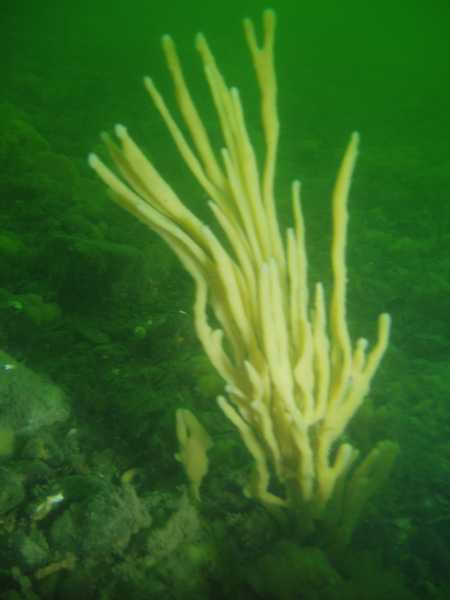
Barry focused on Gallanach, to confirm the presence of Funiculina quadrangularis, and the Wormery in Loch Creran, to confirm the identity of the blue worms photo’d in 2012 (MCS dive trip to Oban (Sept 2012))
Gordon looked to explore new areas around Loch Creran. He also noted that the tides during our trip in March might give us some very good drifts through the Creran Narrows.
Thanks to everyone to turned out for this meeting – in pretty horrid weather!
Gallanach, near Oban, is an old favourite of the group, with an interesting dive from the camping field on the shore. This year we carried out some preliminary survey work here, and at the inner basin in Loch Creran, with the option of extending it into a broader project next year for everyone to get their teeth into. We also had one dive on the wormery in Loch Creran – where we spotted a number of blue variants of the reef building worm Serpula vermicularis (previously we have reported a colour range between white and brick red).
One of the nice surprises at Gallanach was a cooperative curled octopus (Eledone cirrhosa, shown above), who hung about for a few photographs.
We are currently working up the dive notes for a first stab at a survey for our survey pages.
Images and sea-life survey information from the Lancashire MCS group’s dives around Calve Island, Tobermory Bay have been converted into a display at the Mull Visitor Centre. We hope this will encourage people to take more interest in the (usually) unseen wildlife around our coasts, and recognise it as forming unique and precious ecosystems.
Last month’s meeting on Surveying the Piel Channel, by Ron Crosby, drew another big turn out. The Piel Channel is one of the very few satisfactory shore dives along the coasts of Lancashire and Cumbria. Our coastline has very gently sloping muddy bottoms.These make them very susceptible to disturbance from wind or tide, resulting in very poor visibility. It is not that there is no life here – quite the opposite, but it is often dug in and hard to see…
By contrast the tidal race of the Piel channel cuts the boulder-clay sediment to a depth of about 12m within a few metres of the shore. While visibility is still often very poor, the comparatively steep profile means tat all of the life in the bay is compacted into a small area, and a wide range of habitats is very easily accessible.
For more information on the range of organisms found in the Channel, see our surveys page:
After watching a dredger make its way up the channel towards Barrow we really didn’t expect much from this dive, but the weather was good, and we hoped that there would be some visibility… As it turned out the dive was very pleasant, with between 50cm and 1m visibility – in fact good enough for a few photographs!
Ron confirmed that there was kelp (Laminaria hyperborea) in the channel at a depth of between 3 and 5m (below LWM) – the individuals are very stunted (about 1m in length) perhaps due to the lack of light, though poor footings for their holdfasts may mean that larger individuals will get washed away! There is rather more red algae, but sessile animals dominate the ecosystem, with a diverse range of sponges and hydrozoa. On these are a range of grazing nudibranchs.
A full list of species found at this site can be found on our surveys page:
Almost perfect conditions for our latest visit to Roa Island to dive in the Piel Channel. Underwater visibility was about two metres max. but the bright sunlight passing through the water made for a vibrant and very colourful dive. Under these conditions the quantity and diversity of marine life which makes this location so special is plain to see. The depth range of the dive was about three to six metres below low water neaps, the substrate mainly boulders and cobbles with muddy patches between. Many species of seaweeds covered the boulders, blue mussels and periwinkles were everywhere. Butterfish, shanny and corkwing wrasse were also spotted. In just a small area of about half a square metre on the sponge bed four species of sponge, five species of crab, anemones, worms, nudibranchs, hydroids and common starfish were recorded. After recording common brittle stars on the lower shore on a shore walk a couple of weeks before it was hoped the we might find some on the dive, but unfortunately this was’nt to be. We look forward to our next visit on saturday 11th. August.
A warm sunny evening and a low spring tide, the perfect conditions for exploring the shore. The venue, Roa Island with it’s boulder and muddy beach and a couple of man made structures providing addtional habitat types. The top of the beach is composed mainly of large boulders with barnacles, wracks and large patches of blue mussels. On the middle of the shore, shore crabs, edible periwinkles, and dog whelks with thousands of eggs were all very common and here three or four European oysters were recorded. The underside of the jetty provides homes for clumps of mussels, sea squirts, hermit crabs and at the seaward end of the jetty a couple of European cowries were spotted. Moving further down the shore and searching beneath the boulders revealed both broad and long clawed porcelain crabs, chitons and we were suprised to find common brittle stars, an animal no where near as common in the channel as it was some years ago. Other inhabitants of this lower part of the shore were grey top shells, butterfish, common stars and colourful patches of both green and orange sponge. In the shallow pools left by the tide the tubes of peacock worms stood upwards from the mud and tiny anemones were to be seen amongst the stones. As the tide reached it’s lowest point we were able to see peacock worms with extended tentacles collecting food passing by in the water. We had spent a couple of very enjoyable hours recording and photographing in excess of thirty different species of plant and animal on this very small area of shore. Many thanks to Lewis for organising the event.
Mermaids purses, jellyfish, whelks and crustacea - all part of the strandline (click for a larger version)
An interesting series of presentations looking at some common items washed up on the British strandline. Talks covered the differences between amphipods and isopods (shown above!), some superb images of jellyfish in the sea (my sketches really don’t do these justice!) – and some less attractive photos of them after they have washed up. The activities of baby whelks (you would not invite them to dinner). How to identify a mermaid’s purse – and why you might want to!
Mermaid’s purses are the egg-cases of skates and some sharks, many of the species that produce them are endangered, so recording what you found and where helps build up a picture of the distribution of these species. UK species can be identified and reported online at: www.eggcase.org
Thanks to Ron, Lewis, Gordon and Jo for their contributions to the MCS monthly meeting, 13th June at Capernwray Dive Centre