Tiny single celled plants called phytoplankton support the food chain of the world’s oceans. By locking up carbon dioxide during photosynthesis, they are also recognised as a vital component buffering the earth’s atmosphere from burning fossil fuels.
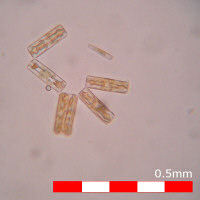
The numbers of phytoplankton are limited by the availability of sunlight and nutrients. Above 50°N in the Atlantic it had been assumed that winter turnover of water masses replenished the nutrient supply, and that the limiting factor for phytoplankton growth was a combination of grazing, and lack of silicates (a vital micro-nutrient for diatoms, pictured). Recently, however, experimental evidence, gathered by scientists at the University of Southampton, indicates that it is lack of iron, another important micro-nutrient, that is limiting the growth of phytoplankton.
Experiments elsewhere, aimed at increasing the amounts of carbon dioxide removed from the atmosphere, have tried to boost phytoplankton production by artificially adding more iron to water bodies.
From Science Daily
Posted: July 8th, 2009
Posted in Plankton, Science

Seagrass is a general term for the only important ‘higher’ plants found in the sea. Unlike algae (seaweeds) they prefer to colonise sandy bottoms, where they are important for stabilising the sediment, and help provide a habitat for a diverse range of wildlife. Whilst seagrass is an important habitat defining species, is is not nearly as competent underwater as the algae, and, in particular, it appears to suffer greatly in turbid (cloudy) water. As a consequence it does not tollerate any coastal development that kicks up silt or increases pollution.
Anecdotal evidence suggests that seagrass meadows in the UK are recovering since the 1930’s when large areas were wiped out by disease. Globally, however, the situation appears to be less good. Scientists from the University of Maryland have just published a report emphasising the relationship between coastal development and increased population pressure in this region around the worl, and its effect o nthis important habitat.
Further reading:
UK Biodiversity action plan for seagrass beds
Loss of Coastal Seagrass Habitat Accelerating Globally (University Maryland report)
Above right: Zostera sp., photographed in Loch Linnh by the author
Barry
Posted: July 6th, 2009
Posted in Conservation, Science
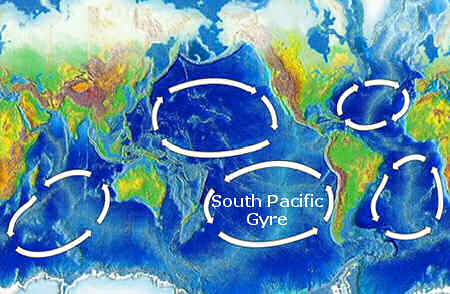
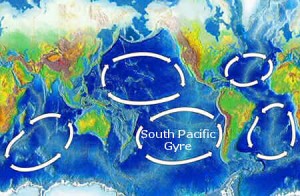 The oceanic gyres are areas of water at the heart of the major oceans. They are a long way from land, so receive little sediment. Estimates of sedimentation rate for the South Pacific Gyre, the largest of these bodies of water, are for less than 10 cm of sediment to accumulate in each million years…
The gyres are bordered by strong boundary currents, but are themeselves almost entirely still. As a consequence, there is very little nutrient influx, the water above is clear, but the sediment contains very little life. Rhode Island Scientists are speculating that the levels of nutrients may be so low that life in the deepest sediments may be reliant on hydrogen produced by water being split by the radioactive decay of minerals in the sediments!
More information:
University of Rhode Island press release (via Science Daily Deadlines)
Image of the five main oceanic gyres modified from NOAA via Wikipedia (full article and original image)
Posted: July 1st, 2009
Posted in Science
For contributors, the MCS blog has just been updated, hope you like the changes to the edit facilities!
Barry
Posted: June 30th, 2009
Posted in Uncategorized
Every year we get news of toxic algal blooms killing fish or making water unsafe to bathe in or drink from, but why do algae produce these toxic blooms? The easy answer is that they kill off predators, so the algae survive. Effectively, the toxin is there as a defence against predation. The problem with this theory is that micro-algae have to divert a lot of energy to produce toxins, so in most scenarios the toxic algae would be out-competed by species that did not go to the trouble!
Recently scientists have uncovered a more aggressive reason for toxin expression by algae, and one that gets round this problem. In the new theory the toxin is actually expressed against other algae in the water. Once killed, these dead phytoplankton leak nutrients back into the water that can be used to help fuel a toxic bloom.
From Science Daily Headlines
Posted: June 30th, 2009
Posted in Science
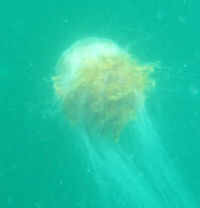
For some time there has been a growing worry about the numbers of jellyfish, with massive swarms being reported in Hawaii and the Gulf of Mexico in late 2008 (Science Daily article).
Jellyfish swarming is a natural event, but evidence is mounting that human activities are favouring these occurrences. Nutrients entering seawater from land run-off increases phytoplankton numbers, and over-fishing reduces the competition for this food. The consequence? – a Jellyfish swarm that can be several kilometres across!
Posted: June 10th, 2009
Posted in Science
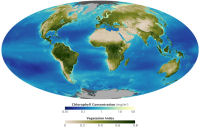
NASA’s Earth Observatory has just published a set of images showing average global primary production fro the period 1999 to 2008. The images show the most highly productive areas of land and ocean by colour (demonstrating again how productive the seas are off the UK). You can see how transient events – like an unusually wet year, can dramatically increase the vegetation levels over desert areas. As the covering notes say, however, it is not so clear why oceanic productivity varies so greatly from one year to the next. For more details and all of the images from this super gallery:
Global biosphere
Barry
Posted: June 8th, 2009
Posted in Science
I too have to thank Gordon for doing most of the real work in organising the weekend. The drift through the narrows was one of those dives that gets imprinted in your memory, and I couldn’t believe the numbers of sea lemons on the stanchion when we dived on slack. The life and colours were brilliant. I hope those doing the photography ‘course’ found it useful and enjoyable, and that you’ve looked at your pictures and filled in that matrix 🙂
If anyone’s interested I’ve put some of my pictures from the weekend on the web at
http://www.zen102367.zen.co.uk/diving/lochcrerran09/crerran09.html
Lewis Bambury
Posted: June 1st, 2009
Posted in dive trips
We’re just back from a very welcome long dive weekend near Oban, combined with an informal underwater photography course given by Lewis Bambury. On the 23rd we had two dives starting from the old Creagan Ferry slipway. This is situated on the North bank of Loch Creran, and about 100m after the new bridge, with a good sized layby to kit up in.
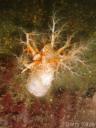
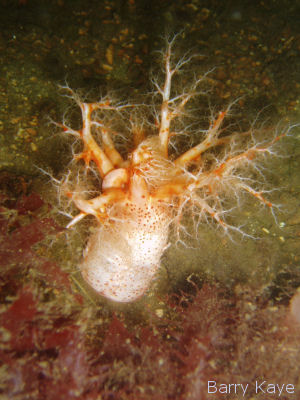
The weather was very wet, and the underwater visibility, at between 2 and 4m was unusually poor for the area – adding to the challenge of getting good photos (good photos were taken by others on the course, unfortunately you’ll have to make do with mine!). The morning dive was a low water bimble around the slipway itself, Loch Creran is home to numbers of sea cucumbers, of which the most commonly encountered is Psolus phantapus (see photo), which is bright orange, and these were the photographic high-spot of this dive, though there were also plenty of crabs, dead-mens fingers and squat-lobsters!
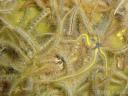
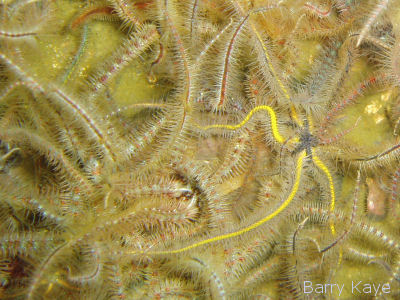
In the afternoon we drifted with the flood tide into the inner basin of Loch Creran – being at springs, there was with strong current. Or at least it was after we found it! – We’d taken a direct bearing to the bridge, and so ended up too close to the North side of the channel to get into the main current until we were pretty much under the bridge itself. Our route did take us through a deep basin immediately North West of the bridge, however (see charts). This contains an extensive brittle-star bed, which looks rather grey and unappealing at any distance, but go in close, and the grey hairyness resolves into myriads of brightly coloured brittle-stars (see photo). These are interspersed with the occasional giant starfish (typically 0.5m from arm-tip to arm-tip).
The final drift through under the bridge was very exhilarating, though with the stronger spring tide it was not possible to stop where we had intended, necessitating a 100m walk in full kit back to the car.
All in all, an excellent weekend, so thanks to Lewis and Gordon (who organised 5* accommodation and dive details).
Barry Kaye
Posted: May 27th, 2009
Posted in Uncategorized
Cod fisheries off the American coast have now largely collapsed, and recent research, by the University of Iceland and Marine Research Institute in Reykjavik, indicates that the remaining commercailly viable fisheries around Iceland are also teetering on the brink.
For a long time we have known that fishing exerts a strong pressure on the size and age at which cod mature. The scientists report that this has resulted in a reduction in the length at which a fish becomes mature by nearly one centimeter per year. The loss in size at maturity has a corresponding loss in fitness, with shallow water fish (the most heavily hunted) having only 8% of the fitness of their deep water counterparts. These changes are almost certainly hereditary, the fish responding to the dead-end that modern fisheries management has forced them into.
The authors speculate that the immediate establishment of large no-take reserves might relieve selection pressures on the fish, and avert a population collapse.
Full article Árnason et al. Intense Habitat-Specific Fisheries-Induced Selection at the Molecular Pan I Locus Predicts Imminent Collapse of a Major Cod Fishery. PLoS ONE, 2009; 4 (5):
This article via Science Daily Headlines
Posted: May 27th, 2009
Posted in Uncategorized