An expedition, led by Dr Anthony Grehan, has discovered extensive deep water corals, standing up to 2m high, off the Irish Coast. Possible sites for investigation were identified from the high resolution bathymetry collected by the Irish National Seabed Survey, and then identified by deep-sea Remote Operated Vehicle (ROV).
Via Science Daily Headlines
The depth that the corals were recorded at is not recorded in the article, or the main page on the NUI dsite. The Porcupine Bank, close to where the corals were dicovered, is between 80 and 100 fathoms* deep (140-180m), however, so we will not be arranging a dive trip(!). As an aside, the Porcupine bank is named after the Naval research vessel HMS Porcupine, from which the Porcupine Natural History Society also derives its name – small world…
Porcupine Marine Natural History Society
*From Haddock on the Porcupine Bank, September 1944 by C.F. Hickling MA
Posted: May 27th, 2009
Posted in Science
Basking sharks are welcome visitors to the British coastline during the summer months, when they swim close to the surface straining the sea water through modified gills to collect plankton. The species is listed as endangered and the MCS promotes and collects public sightings, through the Basking Shark Watch (BSW) project to try to help us understand more about this enigmatic animal.
Until recently, while summer sightings were quite common, nothing was known about the animals distribution during the winter months. Recently (May 14 2009), however, researchers have filled in the blanks. Satellite based tracking systems have followed basking sharks as they overwinter at depths between 200m and 1km, while migrating through the tropical waters of the Atlantic. The sharks were observed to stay at these depths for weeks or months at a time, effectively vanishing from sight!
For more information:
Science News Report
To report a sighting, or for more information on basking sharks in UK waters:
MCS basking sharks reportings
Posted: May 14th, 2009
Posted in Conservation, Science
An article in The Times newspaper by Frank Pope ( Ocean correspondent of The Times) brings home the immense value of the treasure trove of nature in the Chagos Archipelago, a British Indian Ocean Territory. The vast tropical, marine area belongs to Britain and is directly administered by the British Government, yet few British people know anything about it.
This is by far Britain’s richest area of marine biodiversity. It has the world’s largest coral atoll, its cleanest seas and its healthiest coral reefs.
As Frank pope says, the Chagos is indeed comparable to the Galapagos and the Great Barrier Reef, and provides the British people with an extraordinary opportunity to protect a precious natural piece of the planet.
Proposals for a Chagos Archipelago Conservation Area are being discussed within the Chagos Environment Network by the Chagos Conservation Trust, the RSPB, The Royal Society, Pew Environment Group, The Linnean Society and the Zoological Society of London.
Drawing on best practice in other great sites, the aim would be to: protect nature, including fish stocks (benifiting neighbouring countries); benifit science and support action against damaging climate change; be compatable with security; be financially sustainable; and provide some good employment opportunities for Chagossian and other people.
To read full article visit: A Jewel in the Indian Ocean’s Crown.
Posted: February 4th, 2009
Posted in Conservation
From the Telegraph newspaper, comes this story about an octopus at a German aquarium, who’s bored and angry because it’s shut for Winter and there are no visitors. Apparently, he likes to juggle hermit crabs, rearranged the aquarium, and figured out how to short the lights with carefully aimed jets of water. A warning tale to aquarium owners everywhere- give your octopi plenty to keep them amused!
Here’s another census/catalogue/portal of marine life. OBIS is the Ocean Biographic Information System and claims to be “a spatially and temporally interactive online archive for marine mammals, sea turtles and seabirds data”. It takes contributions from researchers all over the world and is based at Duke University in the US.
Posted: December 12th, 2008
Posted in Uncategorized
The Encyclopedia of Life is a fantastic, and very ambitious new website, which aims “to organize and make available via the Internet virtually all information about life present on Earth”. You can get involved by adding photos to their flickr group, or become a curator or contributor. I’d like to see more UK and marine-related partners contributing data (like the MCS for example), but it’s a great start!
Posted: October 1st, 2008
Posted in Blogroll
After a weekend of heavy swell pounding into the rocky gullies on the east coast which prevented any thoughts of diving, and this was July, Monday dawned bright and sunny , the swell was replaced by an almost smooth sea with in excess of 10 metres underwater visibility.
Nestends gully at Eyemouth must have the easiest access to the water of any dive from the shore anywhere in the UK. From the point of entry you immediately drop into a few metres of water amonst quite a dense healthy kelp forest with all the usual kelp forest inhabitants.
As the gully continues downward and the forest is left behind the floor is made up of large boulders, stones and sandy patches, again all supporting an abundance of marine life. The walls of the gully rising almost vertically towards the surface are covered with anemones and soft corals. Sea slugs, squat lobsters and crabs lurk in the many cracks and crevices and snake pipe fish and scorpion fish are usually quite common sights towards the mouth of the gully.
Across to west coast to Lochaline on the Sound of Mull. Another easy access walk in dive from the shore. A short swim down over the white sand with its numerous tube anemones and the occassional kelp covered rocky outcrops brings you to the top of the Lochaline wall. This is an almost vertical rock face with cracks, crevices and ledges, which plummets down to more than 100 metres deep.
There is a great diversity of marine life living on the wall, seaweeds, sponges, anemones and worms etc. Over the past three years members of the Group have recorded more than 100 different species of plants and animals. On this dive to a depth of 30 metres there seemed to be an abundance of fish including, leopard spotted gobies, corkwing wrasse, scorpion fish and dozens of juvenille cockoo wrasse.
Our list of recordings consists of the common and the more obvious plants and animals, a concentrated effort looking at sponges, hydroids and sea weeds etc. would at least double the numbers on our present list, and what about the life at the bottom of the wall?, that could be very interesting!
About 20 miles east brings us to Loch Creran, a favourite dive location with our Group for many years. There are a number of very good varied dive sites with easy access from the shore around the loch, but when the tides times are right Creagan Bridge Narrows is, I think, the outright favourite. Vey different to the dive at Lochaline wall, the narrows is only about 6 metres deep at low water, start the dive just before the end of the ebb, drift through the channel, as the tide turns at the end of the period of slack water you then drift slowly back to the point of entry. This is a very crisp and vibrant site where you can find many plants and animals that are associated with high energy locations.
These are three very easy access sites, suitable for novice diver and upwards, each with their own very special characteristics, there is always lots to see, in fact you often see something new every visit, so its always nice to return.
Posted: August 23rd, 2008
Posted in dive trips
From NOAA and National Geographic this week- two fantastic sets of photos. The first is NOAA’s gallery of coral photos. There’s a lot of images here and the galleries are not that easy to navigate around but there are some beautiful pictures, including possibly my favourite: the orange fireworm. The second is from National Geographic, of Sailfish rounding up a school of sardines in the Gulf of Mexico. You can watch the poor sardines being picked off one at a time until none are left, but the sailfish are impressive looking predators too.
Posted: August 22nd, 2008
Posted in Uncategorized
Scientists around the globe are working hard to try and find out, MarineSpecies.org now have over 122 000 species, and estimate a total of 230 000. During their work, however, they have found that a lot of our ‘species’ are really only synonyms for the same organism. The leader in the synonym race is the breadcrumb sponge (Halichondria panicea). This is common on a range of substrates, and adopts a wide range of shapes and colours in different habitats – if you dive you’ve almost certainly seen it! Its predilection to changing its colour and shape have resulted in scientists giving it no less than 56 synonyms…
MarineSpecies.org is affiliated to the Census of Marine Life, which readers might also find interesting.
Posted: July 17th, 2008
Posted in Conservation, Science
One of the other dives over the weekend was a drift through the Creran narrows – there are some super photos taken by Lewis available on his website at: Loch Creran photos June 2008 (Lewis will be giving us a talk on underwater digital photography later in the year – keep an eye on the diary for more information!)
More information about Loch Creran is available in a new guide published by the Argyll and Bute Council. To quote from their website “(the guide) describes and illustrates the amazing wildlife and natural habitats found in and around Loch Creran, its geological and historical background as well as a description of current commercial and leisure activities.” To find out more and download a copy of the guide: Loch Creran Guide (Thanks to Louise for this info).
Barry
Posted: June 19th, 2008
Posted in dive trips
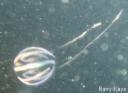
Our last dive weekend to Oban was a combination of good visibility and super dive sites, so thanks again to Gordon for organising this. I think the prize for most abundant squidgies over the weekend has to go to the cnidaria (jellyfish and related), and our encounters with them started on Friday evening, with a night dive on the sea pen bed at Galanach.
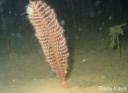
On entering the water we were surrounded by a drift of sea goosberies, the bands of cilia along their sides rainbowing in our torch beams. The sea pen bed starts quite sharply at about 20m depth, appearing out of the dark. We have to report that, rather disappointingly, we didn’t see any phosphorescence from the Pennatula phosphorea, but did see a large number of individuals of both this species and Virgularia mirabilis, including small (juvenile?) indiviuduals.

Jo spotted a pogge (Agonus cataphractus) probing the mud beneath the sea pens – which I was pleased to be able to identify immediatly, folowing Gordon’s talk on Roa Island the previous week!
Barry
Posted: June 17th, 2008
Posted in dive trips


