Early morning on Saturday 16th July 2022 we walked out, following the tide, from the Battery at Morecambe to Conger Rock, a large eratic boulder close to the Low Water Springs level between Morecambe and Heysham. The purpose of our walk was to check on the honeycomb worm reefs that had last been seen by the group in this area over thirty years ago!
Above: Lewis, Mark and Jo at Conger Rock; the Sabellaria historically the honeycomb worm reefs started just beyond this point.
Honeycomb worm reefs are built by small worms of the species Sabellaria alveolata, and can be found from close to the high water mark down to extreme low water, where the largest reefs can reach a height of 60cm. The reef is formed from sand grains stuck together to form tubes that protect the worm from predators and dessication when they are exposed at low water.
On our walk we found that while the reef is still present, much of it is in poor condition, showing signs of erosion, with no live worms. The erosion, however, allows us to see the structure of the reef in greater detail, as in the close-up photograph below.
Above: Detail of the honeycomb worm reef, showing the tubes formed from glued-together sand grains. Here the reef is dead, and the matrix between the tubes has been eroded out. It will disintegrate over time, hastened by bad weather.
Honeycomb worm reefs tend to by cyclical, and while many were in a state of decay, there were also sections of reef in relatively good condition. The reefs stretched for a distance of several hundred meters along the low water mark back towards Morecambe.
We enjoyed a super cooked breafast at the Beach Cafe on our return to the Battery!
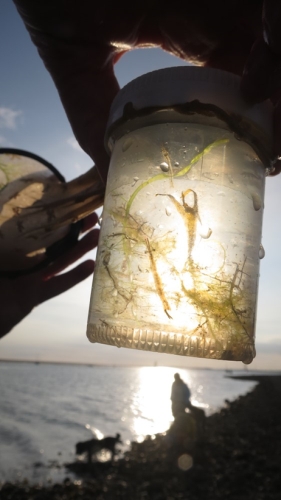
From the start of 2022 Mark Woombs, Jean Wilson and myself have been sampling plankton every fortnight from the river Wyre estuary at Knott End. The intention of this study is to refresh our understanding of plankton diversity and dynamics in the Bay area, and contribute to studies on the health of the River Wyre. Phytoplankton – microscopic marine plants – are the base of the marine food web, and contribute approximately 50% of the oxygen we breathe, whilst quietly sequestering atmospheric carbon dioxide. Zooplankton are (generally microscopic) animals that convert phytoplankton biomass into food that is accessible to the rest of the animals in the world’s oceans.
In estuarine systems there is never really a shortage of plant neutrients. As a consequence there is the opportunity for phytoplankton to be present in high numbers from early spring, as light levels and surface water temperatures rise, through to late autumn, when grazing combined with lowered growth rates (due to reduced light and temperature) finally cut the poulations back.
Above: Preliminary analysis of phytoplankton results from the river Wyre 2022. Increased daylight triggers a massive, but very short, bloom in Odentella mobiliensis. This is followed by a smaller bloom in Coscinodiscus spp.
This does not mean, however, that the same phytoplankton species dominate our samples throughout the year. In fact, our study to date has revealed a dynamic interplay between phytoplankton species, with different species commming to dominate the total population in succession. The most likely cause of the species population collapses is disease, rather than grazing, though we only have direct evidence for this in one of our phytoplankton families, the Coscinodiscus, where the appearance of the fungal disease Lagenisma coscinodisci in late May coincided with a decline in the numbers, particularly of C. wailesii, which had been the dominant member of the Coscinodiscus to that point.
Plankton species taken during the sampling program were used to illustrate our talk to the Royal Society of Biology on 21st May, but we will have a more complete picture of plankton activity in the Wyre at the end of the year, and hope to present this work in more detail then.
Two of our quarterly beach cleans/surveys took place on April 24th and June 15th with 12 volunteers each, so thank you again to those who took part. The June one was particularly enjoyable with the warm, late sun. A great way to spend an evening.
As we have found in beach cleans over the last few years, Half Moon Bay continues to be cleaner than in the past. The litter we find is mainly in the form of small, plastic pieces which often is found in the strand line seaweed. We don’t take away heavy bags filled with rubbish but, we are taking away the dangerous fragments of plastic which can be so toxic to marine life. Define worth the effort!
You can view our survey data on the website which includes pie charts so you can see the results of our survey data. They provide a colourful reference and it’s a visual way to see the percentages of litter collected.
The next beach clean at Half Moon Bay will be the annual national Great British Beach Clean which takes place between the 16th and the 26th September 2022.
We will meet on Saturday 24th September at 3:00 pm. Please register on the National MCS website in the usual way.
Views along the Morecambe Bay Cycle Path. Photos by Lewis Bambury
The Bay Cycle Way will take you on a 130km (80 mile) journey from Glasson Dock, around Morecambe Bay, as far as Barrow in Furness. The route along one of the most beautiful stretches of coastline in Britain, gives the cyclist the opportunity to explore its natural history, transport, industry, landscape and art.
Over the last year Lewis Bambury has cycled the length of the Morecambe Bay Cycle Path in stages, as part of his recuperation from long COVID. His talk to the group in February opened a great deal of interested discussion from those present.
Our next talk is at the George and Dragon, Lancaster, on 9th March 2022. Presented by Mark Woombs (Lancashire MCS/CAOLAS), it will look at the marine life in Loch Tarbert (Isle of Jura). Subscribe to our Newsletter to keep up to date with what is going on at Lancashire MCS!
Photo of Rita with her husband Ron at St Abbs in 2005 (photo by Gordon/Chrissie Fletcher)
It is with great sadness that we have heard about the death of Rita Crosby. Rita was the group treasurer for many years, helping Ron, and ensuring the group stayed on a sound financial footing! Our thoughts are with the family.
Many thanks to all of you who took part in our beach clean on December 12th. On each side of the beach we took 3.5 kg rubbish, although the weight isn’t always the important part. We removed over 300 pieces of plastic of various sizes. This is so important for the protection of marine life and birds. Other items included 55 cotton bud sticks and several other sanitary items including a PPE mask. This is more than usual and may have something to do with the recent storms. I will put the full surveys on the MCS database.
Whatever we remove helps protect wildlife and make the beaches more pleasant to use, so thanks again and hope to see you on another beach clean.
At the George and Dragon, Wednesday November 10th at 19:30. Donations requested to Lancashire MCS.
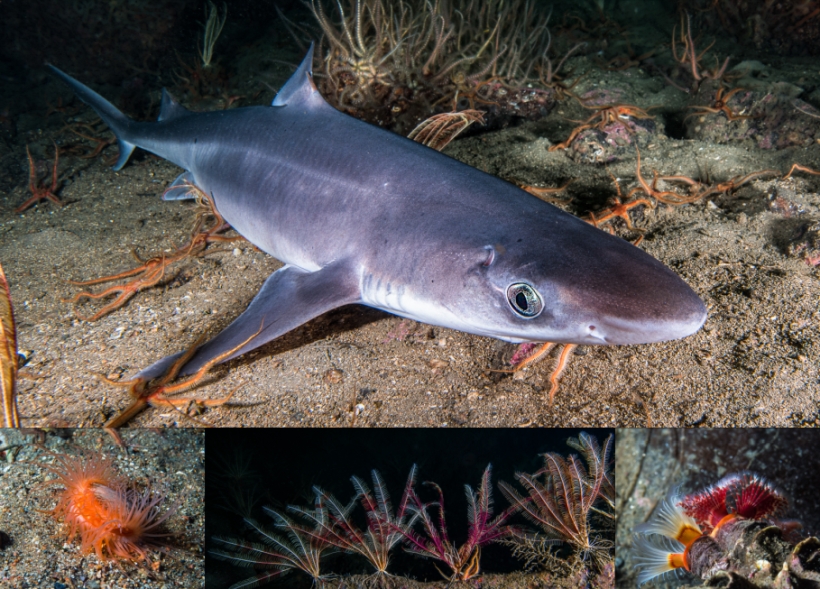
Photograph above: Designated a Marine Protected area to protect (bottom images from left to right) flame shells, Northern feather stars and serpulid worms; the protection of Loch Sunart has allowed the recovery of species such as the spur dog, a relative of the catshark (top). All photos by Mark Woombs
Join marine biologist Mark Woombs as he explores the underwater life of Loch Sunart; from the Sound of Mull to the sheltered waters at the head of the Loch by Strontian (the only town in the world to have a chemical element named after it!). Loch Sunart has been designated as a ‘Scottish Marine Protected Area’, and features a wide range of habitats that are home to some of the most interesting and colourful marine life in British waters.
Please help prevent the spread of COVID by taking a Lateral Flow Test on the morning before joining us!
A big thanks to everyone who turned out on Sunday for the MCS Great British Beach Clean at Half Moon Bay, Heysham. Despite the downpour just before the event we had a good turn out – and the weather turned warm and sunny! Again the beach was pretty clean, allowing us to clean the entire length of the beach down to the high tide mark, collecting only 3.2kg of litter. This did, however, included some sanitary waste – wet-wipes, panty liners, ear cleaners and dog poo, so there is still room for improvement! National MCS will collect all of the data and publish it on their website.
Our next beach clean will be in early December, but we have a short set of winter talks planned starting before then, in November. If you would like to keep up to date with activities, please sign up for our Newsletter:
We do not share subscription details with anyone else without your prior permission; you can unsubscribe at any time through the link at the foot of the Newsletter, or through the subscribe/unsubscribe page above (and linked from all pages on our website).
Our first Roa Island shore walk this year took place on Saturday 24th July. Understandably, given the late decision to hold this, turnout was lower than normal but 5 of us had an interesting time scouring the shore for life. Sadly the first find of any interest was 30-40m of discarded fishing line tangled in the wrack under the walkway to lifeboat station. This took about 20 minutes of patient work to disentangle it so that it could be taken away for disposal. Thankfully the rest of the beach was relatively clear of litter!
Pacific oysters (Crassostrea Gigas)
We saw quite a large number of Pacific oysters Crassostrea Gigas (sometimes known as Portuguese Oyster). These are a non-native commercial species; it’s possible that they have originated from oyster farms in the Menai Straits, although there is an oyster hatchery on Walney Island that puts some immature stock in the Bay to grow on before selling them on to other farms to mature and this may be the source too.
Dislodged sponge
It was noticeable that there were quite a few large pieces of dislodged sponge and sea squirts, probably from deeper water, at the low water line. It wasn’t clear how these had been dislodged, whether it was manmade disturbance – we didn’t see a dredger while we were there for instance – or a natural process, but it did bring some species to view that we may not have seen otherwise. For instance these Oaten Pipe hydroids (Tubularia indivisa) living on one of the detached sponges.
Mysid shrimp captured in a shallow water trawl. Photo Lewis Bambury.
Barry tried some plankton trawls in the shallows where large numbers of mysid shrimp and small (juvenile) fish were swimming against the incomming tide, hoping for it to bring them supper! Microscopic examination revealed a phytoplankton community dominated by pennate diatoms (Proboscia alatum and Rhizosolenia sp.), though we did see one centric diatom Odontella mobiliensis. The trawl also contained some lanceolate Naviculacea (Pleurosigma sp. – probably angulatum), and one example of Bacillaria paxillifera; these are typically benthic/surface dwelling diatoms, but very commony found in shallow water trawls. There were also a number of periwinkle (Littorina littorea) eggs and newly hatched ‘velligers’. Juvenile periwinkles (the ‘velligers’) are planktonic, and use cillia covered extensions of their ‘foot’ (called a ‘vellum’) to swim. This mode of propulsion is very effective in the smaller juveniles, allowing them to make respectable swimming speeds (Olympic qualifiers – for ther size!) as they actively hunt for food, which is usually smaller zooplankton.
Periwinkle egg containing two velliger embryos – very close to hatching! Micrograph by Barry Kaye.
Lockdown has meant that the best tides for this have passed us by this year, but this was the first of two dates that we picked as having the chances of interesting finds. The timing of Spring tides around Morecambe Bay means that the very lowest tides – when we have the best chance of finding some of the creatures that are normally hidden – happen around 6 or 7 am, of 6 or 7 pm, so daylight times are a factor in choosing dates too.
Our next walk is on the calendar for Wednesday 8th September at 19:00 (Low water 0.95m at 19:42, just before sunset).
Report by Lewis Bambury with additions on microscopy by Barry Kaye.
The local group has been running regular beach cleans and litter surveys at Half Moon Bay for over ten years, but recently we have decided to take a wider view, and run some ‘guerilla’ beach cleans, to compare beaches more widely around the area, and see if there are areas that might benefit more from a regular clean.
Above: Morecambe Bay from the Venus and Child statue, with Spartina in the foreground, sea defence boulders and the Bay, and Lake District hills in the background.
Last night (July 21st) many of us took advantage of the good weather to cycle to the Venus and Child statue on Morecambe prom (clost to the golf course), to take a look at the beach there. The shore is composed of a steep bank of cobbles and shingle, the lower reaches of which provides a footing for common seaweeds like Ulva (sea lettuce) and Fucus, going to flat sand and mud further from the shore, with patches of Spartina or cord grass.
The beach clean focussed on the shingle slope, around the high water mark, where litter is most likely to be left as the tide goes out. Over a one hundred meter section we collected 1kg of litter – which is really pretty good, and indicates that this stretch of the coast (from Half Moon Bay to the Golf Course) is in good shape – at least as far as litter is concerned!